Contents
- 1 Pure Sukhad and the Zoroastrian Sacred Fire: How It Is Used in Agiary Rituals
- 2 Why This Article Exists
- 3 The Sacred Fire: What Is Actually Being Tended
- 4 The Five Gehs: The Daily Rhythm Sukhad Belongs To
- 5 The Boi Ceremony
- 6 The Machi: Sukhad in Formal Arrangement
- 7 How a Lay Offering Is Made
- 8 Why Fragrance, Specifically?
- 9 What Else Is Offered to the Fire
- 10 Who Handles Sukhad Inside a Fire Temple
- 11 The Journey of a Single Stick of Sukhad
- 12 Common Misunderstandings About Sukhad and the Sacred Fire
- 13 When Sandalwood Use Rises
- 14 Sukhad Outside the Fire Temple
- 15 Respect, Access and Photography
- 16 What This Means for Anyone Supplying Sukhad
- 17 People Also Ask About Sukhad and the Sacred Fire
- 18 Frequently Asked Questions
- 19 Conclusion
- 20 A Note for Readers With a Sukhad Requirement
- 21 Contact Jai Gurudev Upkaran Bhandar
Pure Sukhad and the Zoroastrian Sacred Fire: How It Is Used in Agiary Rituals
Direct Answer
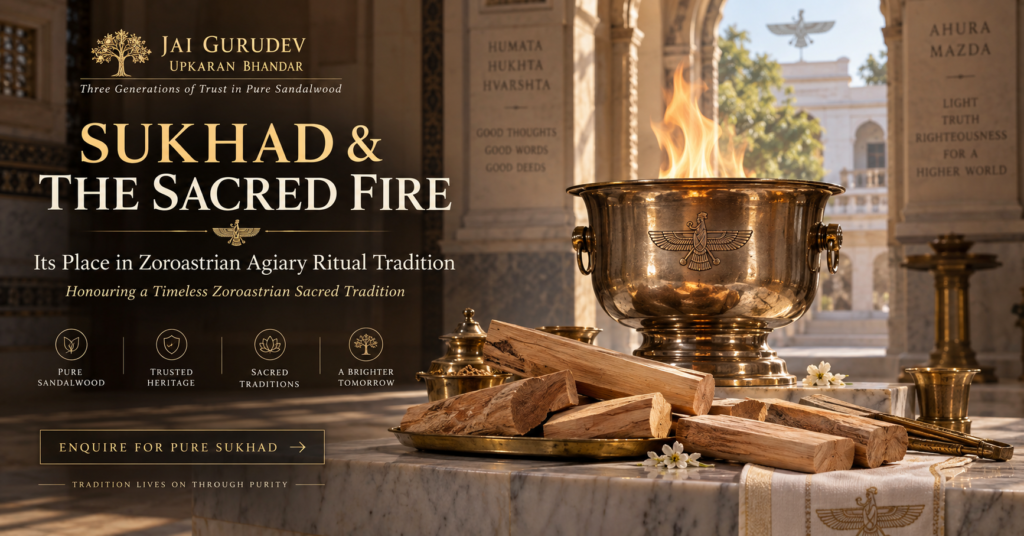
In a Zoroastrian fire temple, Sukhad — sandalwood — is offered to the consecrated fire as a fragrant gift rather than as fuel. Priests tend the fire through the boi ceremony in each watch of the day, and at appointed times build a machi, a throne-shaped arrangement of sandalwood sticks. Lay worshippers may also offer sandalwood when they visit.
Why This Article Exists
Sandalwood is the part of Zoroastrian worship that outsiders notice first and understand last. It is easy to write that sandalwood is “offered to the sacred fire” and leave it there. It is harder, and much more useful, to explain what that actually involves: who handles the wood, at what hours, in what form, in what sequence, and what varies between one fire temple and the next.
This article describes the practice as it is documented by Zoroastrian priests, scholars and community writers. Three principles govern it throughout.
First, Zoroastrianism is a living religion, and its institutions are not uniform. An Atash Behram, a mid-sized agiary and a small Dadgah fire are tended to different requirements. Practices also vary with the guidance of the priests who serve a particular fire.
Second, nothing is invented here. Where a detail cannot be verified from reliable sources, this article says so instead of filling the gap.
Third, this is a description of practice, not an instruction manual. Nobody should take a web page as authority on how to conduct or participate in a religious rite. Ask the priests and the managing committee of the institution concerned.
The Sacred Fire: What Is Actually Being Tended
A consecrated fire, not a decorative one
The fire in the sanctum of a fire temple is consecrated. That word carries weight: it means a defined set of liturgical services has been performed to establish the fire, and from that moment it is maintained as a sacred entity rather than relit as convenient. In community writing the fire is addressed with honour — it is referred to as Padshah, king — and it is tended by priests rather than handled casually.
Community writers are careful to emphasise a related point that is often misreported: the fire is a focus and symbol in worship rather than an object worshipped for itself. Zoroastrians pray before the fire, facing it, in the same way that light is treated as a sign of the divine in many traditions.
Three grades, three rhythms
The grade of the fire determines how intensively it is tended.
| Grade | How it is generally described | Tending rhythm |
| Atash Dadgah | The simplest grade of consecrated fire; where no services are in progress a lay person may tend it | Tended at least once daily |
| Atash Adaran | Consecrated from hearth fires representing four traditional occupational groups | The boi ceremony in each of the five watches of the day |
| Atash Behram | The highest grade, consecrated from sixteen sources of fire over an extended period | The boi ceremony in each of the five watches, with a machi offered in every watch |
This table alone answers a question buyers often ask without realising it. An Atash Behram’s sandalwood requirement is structurally different from a small agiary’s, because a formal sandalwood arrangement is made at every watch rather than on selected occasions.
The Five Gehs: The Daily Rhythm Sukhad Belongs To
The Zoroastrian day is divided into five watches, commonly listed as Havan, Rapithwin, Uzirin, Aiwisruthrem and Ushahin. They follow the movement of the sun rather than the clock, so their timings shift through the year and differ by location. Each has its own prayers.
For the sacred fire, the five gehs are the skeleton of the day. Over an Adaran or Atash Behram fire, the boi ceremony is performed in each of them. That is the reason a fire temple’s requirement for wood is continuous and predictable rather than seasonal: the fire is attended five times every day, every day, without exception.
The Boi Ceremony
What the word means
Boi comes from older Iranian words meaning fragrance — the Avestan baodha and the Pahlavi-Pazand boe. The ceremony is named after the aromatic offering, which tells you where sandalwood sits in the ritual’s own understanding of itself. It is not incidental to the rite. It is what the rite is named for.
What happens
At the change of each watch, the officiating priest attends the fire, recites the prescribed prayers, and feeds the fire with dry wood. During the recitation of the Atash Nyash, bells are rung — community sources describe three to nine rings at the words dushmata, duzhukhta, duzhvarshta, meaning bad thoughts, bad words and bad deeds. The bell carries through the building, and it is the sound by which those elsewhere in the temple know the ceremony is under way.
Priests attending the fire cover the mouth and nose with a cloth mask so that breath does not reach the fire, and handle offerings with implements rather than with the hands. After the ceremony the priest distributes rakhya, the sacred ash, to those present, which worshippers traditionally apply to the forehead.
What is actually burned
Here is the point most commercial writing gets wrong. The bulk of what sustains the fire is ordinary dry, clean wood — logs chosen for low moisture content, with babul (baval) commonly named in community writing. Sandalwood is the fragrant offering placed on the fire, not the fuel that keeps it alive.
The practical distinction is worth holding onto: a fire temple has a fuel requirement and a Sukhad requirement, and they are different purchases with different criteria.
The Machi: Sukhad in Formal Arrangement
The machi is the most structured use of sandalwood in the fire temple, and the one with the clearest physical specification.
A machi is an arrangement of substantial sandalwood sticks placed on the fire in the shape of a throne — a seat prepared for the fire as Padshah. Community sources describe it as being built from roughly six to nine large sticks, commonly in the range of eight to ten inches in length, with eighteen inches cited at Iranshah in Udvada.
The number is not uniform, and the variation is meaningful rather than casual. Published descriptions record nine sticks at Iranshah, seven at one Mumbai Atash Behram and six at others. At an Atash Behram, offering a machi in every geh is described as obligatory; at other fires the practice differs.
Two things follow from this that anyone handling Sukhad should know.
Length and straightness are specifications, not preferences. A machi is built. A stick that is short, bowed, split or unsound does not do the job, however fragrant it is. Chips and offcuts, whatever their quality, cannot be arranged into a throne.
Substitution is contemplated, but it is the institution’s call. Community writing notes that where sandalwood is unavailable, other dry, clean wood may be used. That is a statement about tradition’s flexibility, not a licence for a supplier to send something else and call it equivalent.
How a Lay Offering Is Made
A worshipper’s sandalwood offering is surrounded by preparation, and the preparation is part of the offering.
Before arriving. Community guidance describes washing before a visit, preferably including a head-bath, and wearing clean, decent clothing. The head is covered.
On arrival. Footwear is removed before stepping onto carpeted areas. The worshipper performs padyab-kushti — washing the exposed parts of the body with clean water and retying the kushti, the sacred cord — in the outer area before entering the temple proper.
The offering. The worshipper brings sandalwood, which is commonly placed on a tray rather than carried to the fire by hand. The fire itself is attended by the priest, who places offerings using implements. Community writing describes the symbolism directly: the worshipper offers fragrant sandalwood, and the fire returns fragrance — an image regularly connected to the Zoroastrian emphasis on good thoughts, good words and good deeds.
Conduct throughout. Published community guidance asks visitors to avoid disturbing others, to pray without raising the voice, to return borrowed prayer books to their places, and to keep mobile phones switched off. Whether worshippers stand or sit during the boi ceremony is described as varying by tradition.
An important boundary. Entry to fire temples in India is restricted to Zoroastrians, and the restriction is observed strictly — it extends to any space from which the fire can be seen. This is described as a tradition that developed in the Indian Zoroastrian context rather than as a doctrinal requirement, but that makes no practical difference to how firmly it is held. Suppliers, contractors and interested visitors should not expect or request access.
Why Fragrance, Specifically?
Several strands come together here.
The rite is named for it. Boi means fragrance. The aromatic offering is not an embellishment on the ceremony; it is its namesake.
Sandalwood’s fragrance is unusually suited to it. Sandalwood’s scent is soft rather than sharp, and it is released steadily rather than in a burst. It comes from oil held within the heartwood — dominated by alpha- and beta-santalols, which make up roughly two-thirds to four-fifths of the essential oil of Indian sandalwood.
The symbolism is explicit in community teaching. The exchange is the point: something fragrant is given, and fragrance is given back and spread through the space. Community writers connect this to the giving of good thoughts, words and deeds to the world.
Fragrant wood has a place in the tradition’s own texts. Community writing on this subject cites the Vendidad’s listing of categories of fragrant wood suitable for religious use, and some Zoroastrian commentators have drawn on those categories to discuss which alternative woods might be acceptable when sandalwood is scarce or unaffordable. Those are arguments made within the community, and whether any particular wood is acceptable at a particular fire is a question for that institution and its priests — not one that a supplier or a website can settle.
What Else Is Offered to the Fire
- Dry fuel wood (kathi). Clean, thoroughly dried logs of low-moisture timber, with babul frequently named. Offering fuel wood is itself described as meritorious.
- Sandalwood (Sukhad). The fragrant offering, described in community writing as given especially on particular occasions by lay worshippers, and used in machi by priests.
- Other fragrant woods. Discussed within the community, particularly in the context of sandalwood’s cost and scarcity, subject to the guidance of the institution.
One quality criterion runs through all of it and is stated with unusual consistency across sources: the wood must be thoroughly dry. Descriptions reach for words like “bone-dry.” Damp wood smokes, spits and burns badly, and none of that is acceptable in this setting.
Who Handles Sukhad Inside a Fire Temple
Several roles appear in descriptions of fire temple life, and knowing them helps a reader follow what is being described.
| Term | General meaning |
| Mobed | An ordained Zoroastrian priest |
| Panthaky | The priest in charge of a particular fire temple, responsible for its services |
| Dastur | A senior priestly title, associated with high priestly authority |
| Behdin | A lay Zoroastrian — literally, one of the good religion |
| Trustee / managing committee | The lay body responsible for the institution’s administration, including procurement |
Sandalwood typically passes through more than one pair of hands before it reaches the fire. It may be purchased by the managing committee or by an individual worshipper, checked and stored by temple staff, and offered by the priest. That chain is exactly why a written specification is worth more than a verbal preference: the person who buys the Sukhad is often not the person who uses it, and the person who uses it is the one who will notice if the sticks are the wrong length.
The Journey of a Single Stick of Sukhad
It is worth following one piece of sandalwood from end to end, because the chain explains most of the quality criteria that otherwise sound arbitrary.
A sandalwood tree takes many years to develop fragrant heartwood — published work places the beginning of heartwood formation at around the seventh year, with oil content rising substantially in mature trees. The outer sapwood, which carries very little fragrance, is separated from the heartwood. The heartwood is then cut, and here the intended use starts to matter: material destined for machi is cut to length, while smaller and irregular pieces become chips.
The cut wood must be properly dried. This is not a formality. Every source describing what is acceptable at the fire emphasises dryness, and drying is a slow process that cannot be rushed without damaging the wood or leaving moisture trapped inside.
From there it travels — often a considerable distance, since sandalwood grows principally in Karnataka, Tamil Nadu and parts of Kerala while the largest Zoroastrian populations are in Mumbai and Gujarat. Along the way it can pick up moisture, absorb odours from whatever it is packed beside, and lose fragrance to open air.
It is stored, ideally cool, dark, dry and away from anything strongly scented. It is inspected. And finally it is offered — placed on a consecrated fire by a priest who is masked so that his breath does not reach it, using implements so that his hands do not.
Every quality criterion in this trade traces back to that last sentence. The standard is set by the destination.
Common Misunderstandings About Sukhad and the Sacred Fire
| Common belief | What sources actually indicate |
| Sandalwood is what keeps the sacred fire burning | Ordinary dry, low-moisture wood does that work; sandalwood is the fragrant offering |
| An agiary and an Atash Behram are the same thing | Atash Behram is the highest grade of consecrated fire; an agiary most often houses an Adaran fire |
| All fire temples follow identical practice | Practice varies by institution, grade of fire, region and priestly guidance |
| Worshippers place sandalwood on the fire themselves | The fire is attended by the priest; offerings are commonly left on a tray |
| Darker sandalwood is always better sandalwood | Colour varies naturally and can be faked; weight and persistent natural fragrance are better guides |
| Sandalwood powder can replace sticks | Where an arrangement such as machi is involved, sticks of specified length are required |
| Anyone can visit to observe the ceremony | Entry is restricted to Zoroastrians, including any space from which the fire can be seen |
| Sandalwood is scarce because sellers are hoarding it | Supply genuinely contracted; the species is classed as vulnerable and recorded Indian production fell sharply from mid-twentieth-century levels |
When Sandalwood Use Rises
The daily rhythm is constant, but the number of people visiting a fire temple is not. Attendance is generally higher on days of significance in the Zoroastrian calendar and at family observances, and where more worshippers attend, more lay offerings are made. This is a general observation about how religious institutions work rather than a documented figure, and any institution’s own records are a far better guide to its pattern than any generalisation.
Institutions that plan ahead for these periods, rather than buying at the last moment, tend to have a much easier time of it — particularly in a market where sandalwood availability genuinely fluctuates.
Sukhad Outside the Fire Temple
Sandalwood is not used only in the sanctum. Zoroastrian ceremonial life extends into homes and community settings, and sandalwood travels with it.
The jashan is the ceremony most people will encounter. Community sources describe it as a thanksgiving ceremony that may be performed for the living or in remembrance of the departed, requiring one, two, four or more mobeds seated on the ritual mat, and performed in settings that include the home. Fire is maintained in a vessel for the ceremony rather than drawn from the temple’s consecrated fire. Sandalwood is offered to that fire during the ceremony, and loban — incense — is described as being placed on the fire afterwards. Fruits and flowers feature alongside.
One priest’s explanation of the sandalwood offering is worth quoting in substance rather than paraphrasing loosely: the sandalwood serves as food for the fire, and the fragrance is described as something the spiritual beings invoked in the ceremony take pleasure in. The offering is understood as giving, not as decoration.
There is also a collective dimension that rarely appears in commercial writing. Community sources describe fālā ni machi — a contributory machi, where a group of people pool their contributions so that a machi can be offered. The practice is presented as an expression of sharing within the community. It is a useful corrective to the assumption that offerings are always individual transactions: some of the demand for Sukhad is collective by design.
For a household buying Sukhad for a ceremony at home, the practical implications are modest but real. The quantity is small. The date is usually fixed well in advance, which makes last-minute buying unnecessary. And the material still needs to be genuine and thoroughly dry, because it is going onto a ceremonial fire in an enclosed room.
Respect, Access and Photography
A short, direct section, because it matters.
Fire temples in India are not tourist sites, and the inner areas are not open to non-Zoroastrians. Photography and recording inside these spaces are governed by each institution’s rules. Those rules are not an obstacle to be negotiated around, and content that treats sacred interiors as scenery — including generated or staged imagery presented as documentary — does the community a disservice.
Anyone writing about, photographing or supplying to these institutions should work on a simple principle: ask the institution, accept the answer, and describe only what you have been permitted to see.
What This Means for Anyone Supplying Sukhad
Understanding the practice changes what a supplier should ask.
It explains why length matters, because machi is an arrangement and not a heap. It explains why dryness is repeatedly emphasised, because the wood is going onto a consecrated fire in an enclosed sanctum. It explains why demand is steady rather than seasonal, because the fire is attended five times a day without interruption. And it explains why the institution’s own requirement governs, because no two fires are tended to exactly the same specification.
A supplier who has understood this asks about form, length, quantity and timing before quoting. A supplier who has not, sends chips to an Atash Behram.
People Also Ask About Sukhad and the Sacred Fire
Is sandalwood burned as fuel in a fire temple?
No. Ordinary dry, clean, low-moisture wood sustains the fire. Sandalwood is the fragrant offering placed on it.
How many times a day is the sacred fire tended?
Over Adaran and Atash Behram fires, the boi ceremony is performed in each of the five watches of the day. A Dadgah fire is tended less frequently.
What does “boi” mean?
It means fragrance, from the Avestan baodha and Pahlavi-Pazand boe. The ceremony takes its name from the aromatic offering.
What are the five gehs?
The five watches into which the Zoroastrian day is divided, commonly listed as Havan, Rapithwin, Uzirin, Aiwisruthrem and Ushahin. They follow the sun, so their timings vary through the year.
How is a machi arranged on the fire?
The sticks are laid in the shape of a throne, prepared for the fire as Padshah. The number and length vary by institution, and at an Atash Behram a machi is described as being offered in every watch.
Why do priests wear a cloth over the mouth?
So that breath does not reach the consecrated fire. Offerings are likewise handled with implements rather than by hand.
What is rakhya?
The sacred ash distributed by the priest after the ceremony, traditionally applied to the forehead.
Do worshippers place sandalwood on the fire themselves?
The fire is attended by the priest. Sandalwood brought by worshippers is commonly placed on a tray; practice varies by institution.
Frequently Asked Questions
What preparation is expected before visiting a fire temple?
Community guidance describes washing beforehand, wearing clean clothing, covering the head, removing footwear at the appropriate point, and performing padyab-kushti before entering.
Is the sacred fire ever allowed to go out?
A consecrated fire is maintained continuously. That continuity is central to how these institutions are run, and it is why the tending rhythm is unbroken.
What is fālā ni machi?
A contributory machi, in which a group of people pool their contributions so that a machi can be offered together. Community sources present the practice as an expression of sharing within the community.
Does every fire temple use the same number of sandalwood sticks in a machi?
No. Published descriptions record nine at Iranshah in Udvada, seven at one Mumbai Atash Behram and six at others.
Can another wood be used if sandalwood is not available?
Community writing notes that other dry, clean wood may be used when sandalwood is unavailable, and there has been discussion within the community about which fragrant woods are appropriate. The decision rests with the institution and its priests.
How long has sandalwood been used in this way?
Fragrant wood offerings have a long history in Zoroastrian practice, and the boi ceremony’s name preserves that emphasis in older Iranian language. Precise claims about when any particular practice began should be treated cautiously unless they come from a specialist historical source.
Why does dryness matter so much?
Damp wood smokes, spits and burns unevenly. In an enclosed sanctum with a continuously maintained fire, that is unacceptable, which is why community guidance is emphatic about thoroughly dry wood.
Is sandalwood powder used at the fire?
The formal arrangements described in community sources use sticks. Powder is bought by households for other purposes. Where a stick specification exists, powder is not a substitute.
Do Zoroastrians worship fire?
Community writers consistently describe the fire as a focus and symbol in worship rather than as an object of worship in itself. Prayers are offered before the fire.
Can I visit a fire temple to see this for myself?
Not unless you are Zoroastrian. In India, entry is restricted, and the restriction extends to any space from which the fire is visible.
Why are bells rung during the ceremony?
Bells are rung during the prayers, with sources describing rings at the words meaning bad thoughts, bad words and bad deeds. The sound also signals to the rest of the building that the ceremony is in progress.
Are Zoroastrian practices the same everywhere?
No. They vary by institution, region, grade of fire and priestly guidance. Any source that presents one uniform practice for all Zoroastrians should be read with caution.
Conclusion
Sukhad has a defined place in Zoroastrian practice. It is fragrance offered to a consecrated fire that is tended five times a day by priests who neither breathe on it nor touch it directly. It is arranged as a throne in the machi. It is brought by worshippers who have washed, covered their heads and retied the kushti before entering. And it is handled inside institutions whose specific requirements differ from one another in ways that matter.
Understanding all of that is the beginning of treating the material properly — whether you are a worshipper choosing what to bring, a trustee arranging a year’s supply, or a supplier being asked for something you have never had to think about carefully before.
If you would like to understand the meaning behind the practice rather than its mechanics, the companion article on why Sukhad is used in Zoroastrian fire temples takes up that question directly.
A Note for Readers With a Sukhad Requirement
This article is written to explain practice, not to sell anything. If you do have a Sukhad or sandalwood requirement — personal, family or institutional — Jai Gurudev Upkaran Bhandar in Chennai accepts enquiries and can discuss suitable sandalwood options, current availability and PAN India delivery assistance.
Call: +91 63741 66915
WhatsApp: +91 98847 01110
Contact Jai Gurudev Upkaran Bhandar
JAI GURUDEV UPKARAN BHANDAR
Premium Sandalwood Supplier in Chennai, Tamil Nadu, India
Contact Details
Phone: +91 63741 66915
WhatsApp: +91 98847 01110
Enquiry Hours: 24×7 for urgent and emergency sandalwood requirements
Business Address
Jai Gurudev Upkaran Bhandar
136, Amman Koil Street, Sowcarpet, Chennai – 600001, Tamil Nadu, India
Connect With Us
WhatsApp: https://wa.me/919884701110
Instagram: https://www.instagram.com/jai_gurudev_upkaran_bhandar
Facebook: https://www.facebook.com/share/1XYnyFYKR8/?mibextid=wwXIfr
LinkedIn: https://www.linkedin.com/in/jai-gurudev-upkaran-bhandar-0b76b93b5
Customer Support
For product enquiries, pricing, availability, bulk requirements, temple requirements, religious-institution requirements, Sukhad requirements, funeral or emergency sandalwood requirements, and PAN India delivery assistance, contact us by phone or WhatsApp.
Emergency Requirement? Call or WhatsApp us 24×7.