
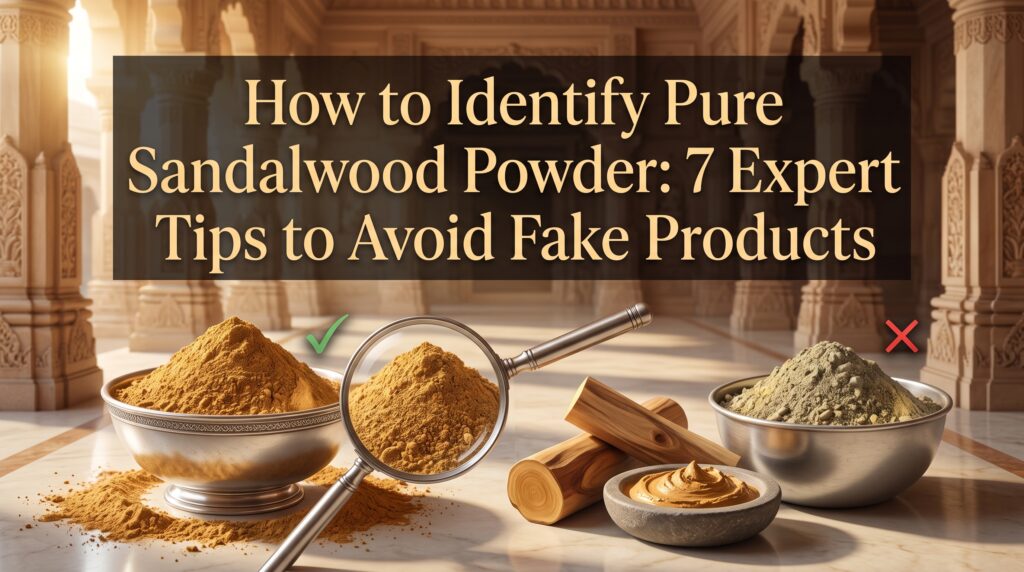
To identify pure sandalwood powder, look for a pale tan or light brown color, a soft and creamy woody smell, and a fine, smooth feel. Real sandalwood makes a silky paste when you add water, and it burns with a gentle, sweet aroma. Fake powder often smells sharp or chemical, fades within minutes, feels gritty, or shows bright dyed color. When you are not sure, ask the seller for the wood species, the origin, and a lab report. This guide walks you through seven simple tests you can do at home.
https://www.instagram.com/jai_gurudev_upkaran_bhandar?igsh=MWJ1NWoybnY5c3N1Yw==
https://www.facebook.com/share/1XYnyFYKR8/?mibextid=wwXIfr
www.linkedin.com/in/jai-gurudev-upkaran-bhandar-0b76b93b5
For More Details Contact-6374166915 / 9884701110
Sandalwood powder is one of the most loved natural products in the world. People use it on their skin, in prayer, in incense, and in old healing traditions. It smells warm, sweet, and calming. But there is a problem. Real sandalwood is rare and costly. Fakes are everywhere. Many products sold as “pure sandalwood powder” are not pure at all. Some are mostly cheap wood dust. Some are colored with dye. Some are just plain flour with a spray of perfume.
If you buy the wrong one, you lose money. Worse, a fake powder can irritate your skin or ruin a religious offering. That is why learning to spot real sandalwood matters so much.
This guide comes from years of hands-on work in the sandalwood trade. At Jai Gurudev Upkaran Bhandar, sourcing, testing, and grading sandalwood is daily work. The tips below are the same checks a trained buyer uses. They are simple. You can do most of them in your own kitchen. By the end, you will know how to tell pure sandalwood powder from a clever fake.
Let us start with the basics, then move to the seven tests.
Contents
- 1 What Is Pure Sandalwood Powder?
- 2 Why Fake Sandalwood Powder Is So Common
- 3 7 Expert Tips to Identify Pure Sandalwood Powder
- 4 Common Adulterants: What Fake Sandalwood Is Really Made Of
- 5 Red Sandalwood vs White Sandalwood: Know the Difference
- 6 How to Store Sandalwood Powder So It Stays Fresh
- 7 What Pure Sandalwood Powder Is Used For
- 8 Where to Buy Pure Sandalwood Powder You Can Trust
- 9 Final Thoughts
- 10 Frequently Asked Questions
- 10.1 How can I tell if sandalwood powder is real at home?
- 10.2 What color is pure sandalwood powder?
- 10.3 Does real sandalwood powder have a strong smell?
- 10.4 What is the difference between red sandalwood and white sandalwood?
- 10.5 Why is pure sandalwood powder so expensive?
- 10.6 Can fake sandalwood powder harm your skin?
- 10.7 What is the water test for sandalwood?
- 10.8 Is Mysore sandalwood the best?
- 10.9 How should I store sandalwood powder?
- 10.10 Where can I buy pure sandalwood powder?
What Is Pure Sandalwood Powder?
Pure sandalwood powder is made by grinding the heartwood of a sandalwood tree into a fine dust. The heartwood is the hard, oil-rich center of the trunk. That inner wood holds the natural oil that gives sandalwood its famous scent.
The most prized type is Indian sandalwood, known by its scientific name Santalum album. It is also called white sandalwood or, in many Indian languages, chandan. This species has a deep, creamy, long-lasting smell. It has been used for thousands of years in India for worship, skincare, and medicine.
There is a key point that surprises many buyers. Only the heartwood carries the strong scent. The outer wood, called sapwood, has very little smell. Good sandalwood powder is made from the fragrant heartwood, not the pale outer layers.
The scent comes from a natural compound called santalol. Pure Indian sandalwood is rich in santalol, mostly two forms called alpha-santalol and beta-santalol. The more santalol, the richer and longer the smell. Labs measure this with a test called GC-MS, which stands for gas chromatography–mass spectrometry. That test can tell exactly how much real sandalwood oil sits inside a powder.
Why Real Sandalwood Is So Rare
Sandalwood is not a fast crop. A tree needs many years to build good heartwood, often 15 to 30 years or more. The oldest trees hold the most oil and the finest scent. Some premium wood comes from trees that grew for three decades before harvest.
The tree is also unusual in how it grows. It is a partial parasite. Its roots attach to nearby host plants and draw some nutrients from them. This makes it harder to farm than an ordinary tree.
On top of that, sandalwood is protected in many places. Governments control how it is grown, cut, and sold to stop illegal logging. All of this keeps the supply small. Small supply plus huge demand equals high prices. And high prices are exactly why fakes exist.
Where Real Sandalwood Comes From
Santalum album grows in India, parts of Indonesia, Australia, and a few other warm regions. Inside India, the Mysore region in Karnataka became world famous for its top-grade sandalwood. Even today, “Mysore sandalwood” is a mark of quality that buyers trust.
There is also a well-known government processor in India called KSDL, short for Karnataka Soaps and Detergents Limited. It has long worked with sandalwood and helped set a standard for quality in the region.
Australia grows a different but real species called Santalum spicatum, known as Australian sandalwood. It is genuine sandalwood, but its scent profile differs from the Indian type, and it usually costs less. This matters later, because some sellers pass off the cheaper species as premium Mysore wood.
Why Fake Sandalwood Powder Is So Common
Before the tests, it helps to know what you are up against. Understanding the tricks makes them easier to catch.
The core reason for fakes is simple. Real sandalwood is expensive, and buyers often cannot tell the difference by sight alone. That gap creates a chance for sellers to cut corners and boost profit.
Here are the most common tricks used to fake sandalwood powder.
First, cheap wood swaps. Sellers grind up ordinary woods like cedar, pine, or scrap timber, then sell the dust as sandalwood. The color can look close, so the eye is fooled.
Second, filler powders. Some products are mixed with starch, rice flour, chickpea flour, or talc. These add weight and volume for almost no cost. The powder looks fuller, but the sandalwood content drops.
Third, fake scent. This is the big one. A seller takes cheap wood or filler, then sprays it with a synthetic sandalwood fragrance made in a factory. Common lab-made scents include names like sandalore and ebanol. At first sniff, the product smells like sandalwood. But the smell is flat and it fades fast.
Fourth, false color. Real sandalwood is a soft, muted tan. To make cheap powder look “richer,” sellers add turmeric or artificial yellow dye. Bright, glowing yellow powder is often a warning sign, not a good sign.
Fifth, species swaps. Cheaper true sandalwood, like the Australian species, gets sold under the premium Mysore name. It is real wood, but not the grade you paid for.
Sixth, a look-alike wood. There is another wood called red sandalwood that is often mixed in or sold as if it were the fragrant type. We will cover this in detail later, because it causes a lot of confusion.
Knowing these six tricks, you can now test any powder with clear eyes. Let us go through the seven expert tips.
7 Expert Tips to Identify Pure Sandalwood Powder
You do not need a lab for most of these checks. A small sample, some water, a plate, and your own senses will get you far. Do more than one test, not just a single one. A fake might pass one test but fail the next. When several tests agree, you can trust the result.
1. Check the Color
Color is the fastest first check. Pick up a small amount of the powder and look at it in daylight.
Pure Santalum album powder is a pale, warm tan. Think of the color of light wood or soft beige. It may lean slightly yellow or slightly brown, but it stays soft and natural. It never glows.
Here is what should make you pause.
Bright, strong yellow often means added dye or turmeric. Real sandalwood does not look like a highlighter. If the color seems too bold to be natural, it probably is.
A deep red or maroon color usually means red sandalwood, which is a different wood with almost no scent. More on that soon.
A pure, chalky white can mean heavy filler like flour or talc mixed in.
A gray or dull, lifeless shade can point to old, low-oil wood or cheap timber dust.
Color alone is not proof. Good fakes match the tan tone on purpose. So treat this as a first clue, not a final verdict. But if the color is clearly off, you can often stop right there.
2. Do the Smell Test
Scent is the heart of sandalwood. This test tells you a lot in a few seconds.
Take a pinch of the powder. Warm it slightly by rubbing it between your fingers. Then bring it close and breathe in slowly.
Real sandalwood has a smell that is:
- Soft and creamy, not sharp
- Sweet and warm, like milk and wood together
- Deep and rounded, with no harsh edge
- Gentle, so you lean in to enjoy it rather than pull away
Fake sandalwood smells different. Synthetic scent often hits you fast and hard. It can smell sharp, plasticky, or overly “perfumed.” Some fakes smell strong at first but feel thin, like a scent sitting on top of the powder rather than coming from inside it.
Here is a useful trick. Real sandalwood reveals itself slowly. The scent unfolds and grows softer and sweeter as it warms. A synthetic scent is loud at the start and then just fades. It does not open up.
Also trust your gut. If the smell feels like a cheap air freshener, be careful. Real sandalwood smells natural, like something that grew, not something that was mixed in a bottle.
One more note. A very weak or almost missing smell can also be a red flag. It may mean the powder is made from sapwood or old wood with little oil left. Real, fresh heartwood powder always carries a clear, pleasant scent.
3. Try the Water Paste Test
This is a classic test used for generations, and it works well. Real sandalwood behaves in a special way when it meets water.
Take about half a spoon of powder. Add a few drops of clean water. Mix it with your finger into a paste.
Watch how it acts.
Pure sandalwood forms a smooth, silky paste. It feels soft and slightly cool on the skin. It spreads evenly, like a fine clay. As it sits, the sweet woody smell often grows a little stronger, because water helps release the natural oil.
A fake or heavily filled powder acts differently. It may:
- Feel gritty or grainy, because it holds coarse sawdust
- Turn into a lumpy or sticky mess instead of a smooth paste
- Release bright color into the water almost at once, which points to dye
- Lose its smell in the paste, or start to smell chemical
There is an old, trusted version of this test. In many Indian homes, people rub a piece of sandalwood on a rough wet stone to make paste for worship. Real wood gives a fragrant, even paste. The powder version follows the same idea.
Try rubbing a little of the wet paste on the back of your hand. Pure sandalwood glides on smoothly and leaves a faint, pleasant scent on the skin even after you wipe it off. That lingering scent is a good sign.
4. Feel the Texture
Your fingers can catch fakes that your eyes miss. Texture is a quiet but powerful clue.
Rub a small amount of dry powder between your thumb and fingers.
Pure sandalwood powder feels fine, soft, and smooth, almost like face powder. It is made from wood, so it is not perfectly silky, but it should not scratch or feel rough. Good grinding turns the heartwood into a fine, even dust.
Watch out for these texture problems.
Coarse, sandy grit usually means low-grade sawdust or cheap wood mixed in. Real premium powder is ground fine.
A slippery, powdery-soft feel that seems too smooth can mean talc or starch filler. Pure wood powder has a slight natural body to it, not a slick, cosmetic slip.
Hard little bits or specks can point to bark, twigs, or leftover material that a careful maker would remove.
Uneven texture, where part feels fine and part feels rough, can mean the product is a blend of real powder and filler.
Feel is best used together with smell and color. When a powder looks right, smells right, and feels fine and smooth, you are likely holding the real thing.
5. Do a Small Burn Test
Fire brings out the truth in sandalwood. This test needs care, so do it safely on a fireproof plate or metal dish, away from anything that can catch fire. Use only a tiny pinch.
Sprinkle a small amount of powder onto a heat-safe surface. Light it carefully, or place it on a hot coal or metal spoon held over a flame with tongs.
Pure sandalwood reacts in a lovely way. It smolders slowly and gives off a soft, sweet, woody smoke. The scent in the smoke is warm and pleasant, the same family of smell you get from good sandalwood incense. The powder usually turns to a fine ash.
Fake powder tells on itself when burned. Synthetic scent often smells sharp, bitter, or chemical in the smoke. Plastic-like fillers can give an ugly, acrid smell. Cheap wood may burn fast with a plain, smoky smell and no sweetness at all. Dyed powder can leave odd-colored residue.
This is one of the strongest tests, because heat releases the real oil and also breaks down fake scents. A synthetic fragrance cannot fake the gentle, natural smoke of true heartwood.
If you make or buy incense, this test doubles as a quality check. Real sandalwood incense smells clean and mellow. Harsh, headache-causing smoke is a sign of synthetic fragrance.
6. Watch How Long the Scent Lasts
Time is the enemy of fakes. This tip takes patience, but it is one of the clearest ways to separate real from synthetic.
Rub a little sandalwood paste or powder on the back of your hand, or on a small strip of paper. Note the smell. Then wait. Check again after one hour. Check again after several hours.
Real sandalwood has staying power. Its scent clings softly to skin and lingers for hours. Even after washing, a faint sweet note can remain. This lasting quality comes from santalol, the natural oil compound. It holds on and releases slowly.
Synthetic scent behaves the opposite way. It smells strong for the first few minutes, then drops off quickly. Within an hour, much of it may be gone. Cheap perfume oils are light and fade fast, while true sandalwood oil is heavy and slow.
This is why sandalwood has long been used in perfume as a “base note,” a scent that anchors a fragrance and makes it last. A powder that loses all its smell in thirty minutes is almost certainly not pure sandalwood.
So if you have the time, let the clock do the testing. A scent that survives the day is a very good sign.
7. Check the Source, Price, and Lab Report
The final tip is about trust and proof. Even the best home tests have limits. The smartest buyers also look at where the powder comes from and ask for hard evidence.
Start with price. Real Santalum album is expensive. That is a fact of the market, because the trees take decades to grow and supply is tight. If a powder is sold as “pure Mysore sandalwood” at a shockingly low price, be very careful. A deal that seems too good to be true usually is. Cheap “pure sandalwood” is often the biggest warning sign of all.
Next, check the source. Buy from sellers who are open and clear about their product. A trustworthy seller can tell you:
- The exact species, ideally Santalum album for premium Indian sandalwood
- The origin of the wood, such as the region it came from
- Whether it is pure heartwood powder or a blend
- How it was processed and stored
Then ask for proof. Serious suppliers can provide a lab report. For oil and high-grade powder, a GC-MS test measures santalol content and confirms the wood is genuine. A seller who tests their product and shares results is showing real confidence in what they sell.
This is where a specialist matters. A dedicated sandalwood house like Jai Gurudev Upkaran Bhandar works only in this field, from raw wood and chips to powder, oil, and beads. That focus builds real experience in grading and sourcing, and it makes clear answers about species and origin part of the normal process. When a seller lives and breathes sandalwood, you get honesty and knowledge, not guesswork.
In short, combine your senses with smart buying. Do the home tests, check the price, know the source, and ask for a report. Together, these give you strong protection against fakes.
Common Adulterants: What Fake Sandalwood Is Really Made Of
It helps to name the exact things sellers use to fake sandalwood. When you know the substitutes, the tests above make even more sense.
Cheap wood dust. The most common filler. Cedar, pine, and other soft woods are ground up and blended in. They add bulk and a woody color, but they lack the true sandalwood scent.
Amyris wood. There is a wood called Amyris balsamifera, sometimes sold as “West Indian sandalwood.” It is not true sandalwood at all. It smells vaguely woody and costs far less, so it is a frequent stand-in and adulterant. The name is misleading on purpose.
Starch and flour fillers. Rice flour, cornstarch, chickpea flour, and similar powders add weight cheaply. They make the product go further while cutting the real content.
Talc. A soft mineral powder used to add smoothness and bulk. It can make a fake feel silky, which fools the touch test if you are not careful.
Synthetic fragrance. Factory-made scent chemicals, such as sandalore and ebanol, mimic the smell of sandalwood. Sprayed onto cheap powder, they create an instant but shallow “sandalwood” smell that fades and often smells sharp.
Artificial dyes and turmeric. Added to fake the warm color. These can bleed brightly into water and stain the skin, which real sandalwood does not do the same way.
Lower-grade true sandalwood. Sometimes the “fake” is real sandalwood of a cheaper kind or region, sold under a premium name. The Australian species, Santalum spicatum, is genuine but different and less costly than top Mysore wood.
Red sandalwood. A different tree entirely, often mixed in or sold under the sandalwood name. It has striking color but little scent. This one deserves its own section.
Most fakes use a mix of these. A typical fake might be cheap wood dust, plus filler, plus a spray of synthetic scent, plus a little dye. That combination looks and smells “close enough” to fool a rushed buyer. But it will fail the burn test and the lasting-scent test almost every time.
Red Sandalwood vs White Sandalwood: Know the Difference
This is one of the biggest sources of confusion, so let us make it simple. Red sandalwood and white sandalwood are not the same tree. They are not even close relatives. They just share a name.
White sandalwood is Santalum album. This is the fragrant one. It is the wood used for scented powder, oil, incense, and perfume. When people say “sandalwood” and mean that sweet, creamy smell, this is the tree they mean. In Indian tradition it is often called chandan or shweta chandan.
Red sandalwood is Pterocarpus santalinus. It is a completely different tree from a different plant family. Its wood is a deep red color, and it has almost no scent. It is not used for fragrance. In India it is called rakta chandan, which means “red sandalwood.” It is valued for its rich color and is used in some skin and beauty preparations, in traditional medicine, and to make dye and crafts.
So red sandalwood is a real, useful product. The problem is not the wood itself. The problem is dishonesty. Some sellers use the shared “sandalwood” name to blur the line. They may sell red sandalwood as if it were the fragrant kind, or mix red powder into white to add color and weight.
Here is how to keep them straight.
If you want fragrance, for worship, incense, or a scented skincare paste, you want white sandalwood, Santalum album. It smells sweet and lasts.
If a product is deep red and has little to no smell, it is red sandalwood. That is fine if you wanted red sandalwood for color or skin care. It is a problem if you paid for fragrant white sandalwood.
Always match the wood to your need, and always read the species name. A clear label and an honest seller solve this instantly. Note also that red sandalwood is a protected species in India, with rules on its trade, so trustworthy sellers handle it carefully and legally.
How to Store Sandalwood Powder So It Stays Fresh
Once you find pure sandalwood powder, good storage keeps it fragrant for a long time. The natural oil is delicate. Heat, light, air, and damp can weaken the scent over time.
Follow these simple storage rules.
Keep it in an airtight container. A glass jar with a tight lid works well. This slows the loss of scent and keeps out moisture. Air is the main thing that dries out the oil over time.
Store it in a cool, dark place. A cupboard or drawer away from the stove and out of direct sunlight is ideal. Heat speeds up oil loss, and strong light can fade both scent and color.
Keep it dry. Moisture is the enemy. Damp powder can clump and even grow mold. Do not store it near a sink or in a steamy bathroom. Use a dry spoon each time you take some out.
Keep it away from strong smells. Powder can pick up nearby odors. Store it apart from spices, cleaners, or anything with a heavy scent.
Handled this way, pure sandalwood powder can stay fragrant for a long time. In fact, real sandalwood is known to age gracefully, holding its scent far longer than any synthetic fake ever could. That lasting quality is one more quiet proof that you bought the real thing.
What Pure Sandalwood Powder Is Used For
Knowing the uses also helps you judge quality, because real sandalwood shines in each of these roles while fakes fall short.
Skincare. Sandalwood powder is a classic face pack ingredient. Mixed with water, rose water, or other natural items, it is used to cool the skin, calm irritation, and add a soft glow. People with sensitive skin should always patch-test first, and this is exactly where fakes with dye or harsh chemicals can cause trouble.
Worship and rituals. In Hindu, Jain, and other traditions, sandalwood paste is applied on the forehead and on idols, and used in daily prayer. The pure, sacred scent is central to the practice. A synthetic fake has no place in genuine worship.
Incense and agarbatti. Sandalwood is a beloved base for incense sticks and dhoop. Real heartwood gives a clean, mellow smoke. Fakes give harsh, sharp fumes.
Aromatherapy and relaxation. The warm, grounding scent is used to calm the mind and ease stress. Its slow, steady release is part of why it soothes so well.
Traditional medicine. In Ayurveda and other old systems, sandalwood has long been valued for cooling and calming uses. Here especially, purity matters, since the benefits come from the real wood and its natural oil.
Across all of these, the same rule holds. The purer the powder, the better it performs. That is the real reason to learn these tests. Quality is not just about price. It is about getting the true benefits you came for.
Where to Buy Pure Sandalwood Powder You Can Trust
The single best defense against fakes is a seller you can trust. Home tests protect you, but a specialist source saves you the trouble in the first place.
Look for a supplier who works in sandalwood specifically, not one who sells it as a random side item. A focused sandalwood business handles the wood, chips, powder, oil, sticks, and beads together, and understands grading from the inside. That depth is what separates a true specialist from a general shop.
Jai Gurudev Upkaran Bhandar is built around exactly this focus. As a dedicated sandalwood house rooted in heritage and tradition, its work covers the full range, from raw sandalwood wood and chips to fine powder, pure oil, incense, and prayer beads. That specialization means clear answers about species and origin, careful grading, and a genuine commitment to purity. When a seller is devoted to sandalwood alone, you are far more likely to get the real thing.
Wherever you buy, apply the checklist from this guide. Confirm the species is Santalum album for premium Indian sandalwood. Ask about origin. Be wary of prices that seem too low. Ask whether lab testing is available. And when the powder arrives, run the color, smell, paste, texture, burn, and lasting-scent tests yourself. A trustworthy seller will welcome your questions, because honest quality has nothing to hide.
Final Thoughts
Spotting pure sandalwood powder is not hard once you know what to look for. The tricks fakers use are limited, and the tests to catch them are simple.
Remember the seven checks. Look at the color, which should be a soft tan. Smell it, and expect a sweet, creamy, natural scent. Make a paste with water and feel it turn silky. Rub the dry powder and confirm it is fine and smooth. Burn a tiny pinch and listen for the gentle, sweet smoke. Watch how long the scent lasts, since real sandalwood lingers for hours. And finally, check the price, know the source, and ask for a lab report.
No single test is perfect on its own. But when you run several and they all point the same way, you can buy with confidence. Real sandalwood rewards this care. Its scent is deeper, its paste is smoother, and its quality lasts. Once you have felt and smelled the real thing, the fakes become easy to spot.
Use these tips on your next purchase. Protect your money, your skin, and your traditions. And enjoy the true, timeless scent that only pure sandalwood can give.
Frequently Asked Questions
How can I tell if sandalwood powder is real at home?
Use your senses and a few quick tests. Check the color for a soft, natural tan. Smell it for a sweet, creamy, long-lasting scent. Mix a little with water to see if it forms a smooth, silky paste. Rub the dry powder to feel if it is fine and not gritty. If you can, burn a tiny pinch safely and check for gentle, sweet smoke. Real sandalwood passes several of these tests together, while fakes usually fail at least one.
What color is pure sandalwood powder?
Pure Santalum album (white sandalwood) powder is a pale, warm tan or light brown. It looks soft and natural, never bright or glowing. Very bright yellow often means added dye or turmeric. Deep red usually means a different wood called red sandalwood. Pure white can mean flour or talc filler. Color is a helpful first clue, but combine it with a smell and paste test to be sure.
Does real sandalwood powder have a strong smell?
Real sandalwood has a clear scent, but it is soft, sweet, and creamy rather than sharp. It grows richer as it warms and lasts for hours. A fake often smells loud and harsh at first, then fades within minutes. A very weak or missing smell can also be a warning, since it may mean low-oil wood was used. The best sign is a gentle scent that lingers.
What is the difference between red sandalwood and white sandalwood?
They are two different trees that share a name. White sandalwood (Santalum album) is the fragrant type used for scented powder, oil, and incense. Red sandalwood (Pterocarpus santalinus) is a deep red wood with almost no scent, used mainly for color, dye, and some skincare and traditional uses. If you want fragrance, choose white sandalwood. If a product is deep red with no smell, it is red sandalwood.
Why is pure sandalwood powder so expensive?
Sandalwood trees grow slowly and need many years, often 15 to 30 or more, to build fragrant heartwood. The tree is also protected in many regions to prevent illegal cutting, which limits supply. High demand plus small supply keeps prices high. So a real “pure Mysore sandalwood” powder cannot be very cheap. A shockingly low price is one of the clearest signs of a fake.
Can fake sandalwood powder harm your skin?
It can. Fakes may contain artificial dyes, synthetic fragrance chemicals, or unknown fillers that can irritate sensitive skin or cause allergic reactions. That is very different from pure sandalwood, which is known for being gentle and cooling. Always patch-test any new powder on a small area first, and choose pure products from a trusted seller to lower the risk.
What is the water test for sandalwood?
The water test checks how the powder behaves when wet. Mix a small amount with a few drops of water into a paste. Pure sandalwood forms a smooth, silky paste that feels slightly cool, spreads evenly, and often smells a little stronger as the oil releases. A fake may feel gritty, turn lumpy, or bleed bright color into the water, which points to dye or cheap filler.
Is Mysore sandalwood the best?
Mysore sandalwood, from the Karnataka region of India, has a long reputation as some of the finest Santalum album in the world. Its rich santalol content gives a deep, creamy, lasting scent. Because of that fame, some sellers falsely use the Mysore name on cheaper wood. So the label alone is not proof. Confirm the species, ask about origin, and test the powder yourself.
How should I store sandalwood powder?
Keep it in an airtight container in a cool, dark, dry place. Air, heat, light, and moisture all weaken the natural oil over time. Store it away from the stove, out of sunlight, and apart from strong-smelling items like spices or cleaners. Use a dry spoon each time. Stored well, pure sandalwood powder holds its scent for a long time.
Where can I buy pure sandalwood powder?
Buy from a seller who specializes in sandalwood and is open about the species and origin. A dedicated sandalwood house such as Jai Gurudev Upkaran Bhandar works across wood, chips, powder, oil, and beads, which builds real experience in grading and sourcing pure product. Wherever you buy, confirm the species is Santalum album, be cautious of very low prices, ask whether lab testing is available, and run the home tests when your powder arrives.