Pure Sandalwood Sukhad for Zoroastrian Fire Temple Rituals: The Product Explained
Contents
- 1 Why the Words Cause So Much Confusion
- 2 The Tree: Santalum album
- 3 From Tree to Sukhad: How the Product Is Actually Made
- 4 The Parts of the Tree, and What Each Is For
- 5 The Forms Sukhad Is Supplied In
- 6 Trade Terminology You Will Meet
- 7 What “Pure” Adds to “Sandalwood”
- 8 Which Form Suits Which Requirement
- 9 Why Indian Sandalwood Is Valued Above Other Sandalwoods
- 10 Sandalwood Oil and Sandalwood Wood Are Two Markets
- 11 What Happens to Sukhad Between Purchase and Use
- 12 Weight, Piece Count and How to Avoid Ordering the Wrong Amount
- 13 What the Fire Actually Requires From the Material
- 14 Three Product Myths Worth Retiring
- 15 Specifying the Product Properly
- 16 People Also Ask About Sandalwood Sukhad
- 17 Frequently Asked Questions
- 18 Conclusion
- 19 A Note for Readers With a Sukhad Requirement
- 20 Contact Jai Gurudev Upkaran Bhandar
Direct Answer
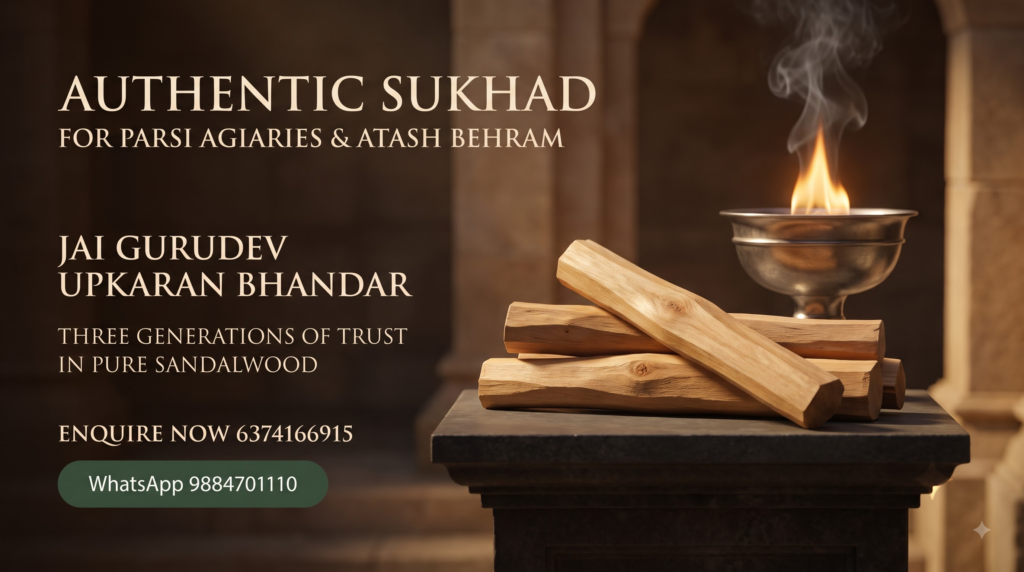
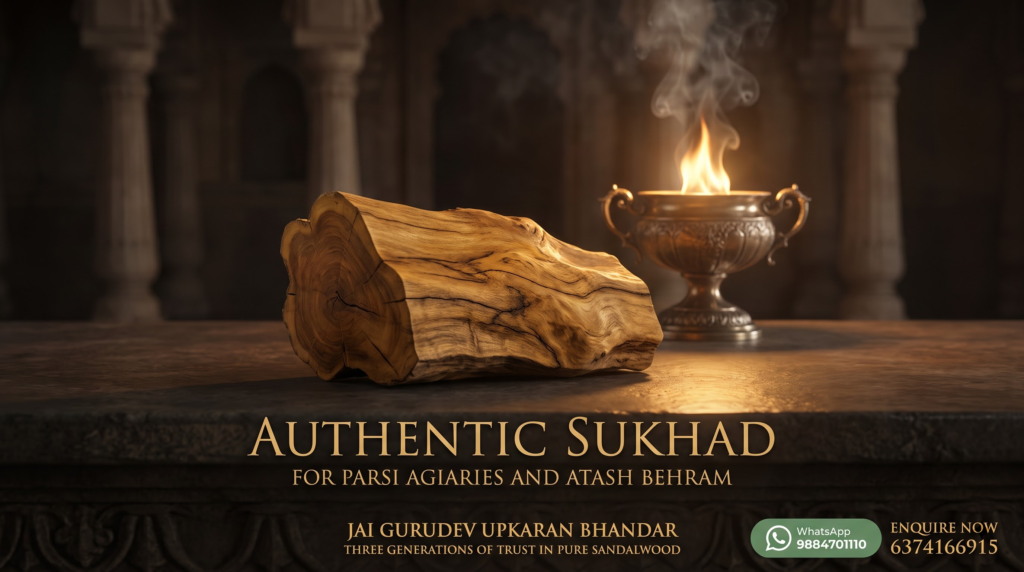
Sandalwood Sukhad is the fragrant heartwood of the Indian sandalwood tree, Santalum album, prepared for religious use. It is supplied as cut sticks, chips, powder or billets. Only the heartwood carries meaningful fragrance; the outer sapwood does not. For Zoroastrian fire temple use, dry, clean heartwood cut to a stated length is what a machi requires.
Why the Words Cause So Much Confusion
A buyer can go through an entire transaction without either party realising they are discussing different things. “Sandalwood” names a genus, a species, a colour of wood, a fragrance, a scented oil and half a dozen products made from all of the above. “Sukhad” narrows it to a religious context but not to a form or a grade. And the trade adds its own vocabulary on top.
This article takes the confusion apart. It starts with the tree, follows the material through processing, sets out the forms it arrives in, and ends by mapping form to requirement. There are no authenticity tests here and no grading framework — those are separate subjects with their own articles — and there is no sales pitch.
The Tree: Santalum album
It cannot grow alone
Indian sandalwood is a hemiparasite. It photosynthesises like other trees, but it also draws water and nutrients from the roots of neighbouring host plants through specialised root attachments. Left without suitable hosts, it grows poorly.
This single biological fact explains a great deal about the market. Sandalwood cannot simply be planted densely in rows like a conventional timber crop and left to itself. Establishing a plantation means establishing a plant community, and that raises both the cost and the failure rate of cultivation.
The product is the heartwood
The fragrant material is the heartwood — the dense inner wood that forms as the tree matures. Published research places the beginning of heartwood formation at around the seventh year of growth, with oil content rising substantially in mature trees and reaching its highest levels in trees well over two decades old. Recorded heartwood oil percentages range widely, from well under one per cent to over four per cent, averaging around one and a half per cent in surveyed material.
Yield is unpredictable in a way that has real commercial consequences. Surveys have found a meaningful share of trees carrying little or no heartwood even after twenty years — around one in seven in one Bangalore survey, and a quarter of trees in one Australian plantation at fourteen years. A grower can do everything correctly and still harvest disappointing wood.
The outer sapwood is pale, comparatively light and carries very little fragrance. It is genuinely part of a sandalwood tree and it is genuinely not worth buying as Sukhad.
The fragrance itself
Sandalwood’s scent comes from oil held within the heartwood, dominated by alpha- and beta-santalols. Published comparisons put these at roughly two-thirds to four-fifths of the essential oil of Indian sandalwood — a far higher share than in other commercial sandalwood species, where figures around 39% have been reported. That concentration is the reason Santalum album has historically been the benchmark.
Where it grows
Indian sandalwood is distributed principally across Karnataka, Tamil Nadu and parts of Kerala, with scattered presence in Maharashtra, Telangana, Madhya Pradesh and elsewhere. Karnataka has historically been the centre of the trade, and “Mysore sandalwood” survives as a quality designation in commercial language because of it.
For Zoroastrian buyers this geography has an obvious consequence: the sandalwood grows in the south, and the largest concentrations of fire temples are in Mumbai and Gujarat. Almost all Sukhad travels.
From Tree to Sukhad: How the Product Is Actually Made
| Stage | What happens | Why it matters to the buyer |
| Lifting | The tree is taken including its root system, because root wood is notably oil-rich | Root-derived material is prized; nothing is left in the ground by choice |
| Debarking | Outer bark is removed | Bark carries no useful fragrance |
| Sapwood separation | The pale outer wood is cut away from the heartwood | The single biggest determinant of what the material is worth |
| Billeting | Heartwood is reduced to manageable billets | Billet size limits what stick lengths can later be cut |
| Cutting | Billets are cut to sticks, chips or fed to grinding | Cut-to-length work wastes more material, which is reflected in price |
| Seasoning | The wood is dried thoroughly | Cannot be rushed; incomplete seasoning is a common hidden defect |
| Sorting | Material is separated by size, soundness and quality | This is where consistency across a consignment is won or lost |
| Packing | Material is packed for storage or dispatch | Determines how much fragrance survives the journey |
Two stages deserve emphasis because buyers routinely underestimate them.
Seasoning. Drying wood properly takes time, and there is no shortcut that does not either trap moisture inside or damage the wood. A consignment that looks perfect and has not been seasoned long enough will behave badly on the fire. When a supplier says material is not yet ready, that is more often honesty than evasion.
Cutting to length. Producing sixty straight, sound, identical nine-inch sticks is a materially different job from producing the same weight of chips. Long pieces require larger sound billets, and every cut that goes wrong becomes chip. This is why cut-to-specification Sukhad costs more per kilogram than loose material of identical quality — a price difference that looks arbitrary until you see the process.
The Parts of the Tree, and What Each Is For
| Part | Character | Typical use |
| Heartwood | Dense, fragrant, the valuable material | Sticks, chips, powder, carving, distillation |
| Root wood | Notably oil-rich | Highly valued; often directed to distillation or premium material |
| Sapwood | Pale, lighter, very little fragrance | Low-value; not suitable as a fragrant offering |
| Bark | No useful fragrance | Removed and discarded |
| Dust and fines | Produced during cutting and grinding | Lowest grade; sometimes sold as powder |
Reading a quotation becomes much easier once this table is in your head. A very low price per kilogram usually means the material sits low on this list.
The Forms Sukhad Is Supplied In
| Form | Description | Best suited to | What to specify |
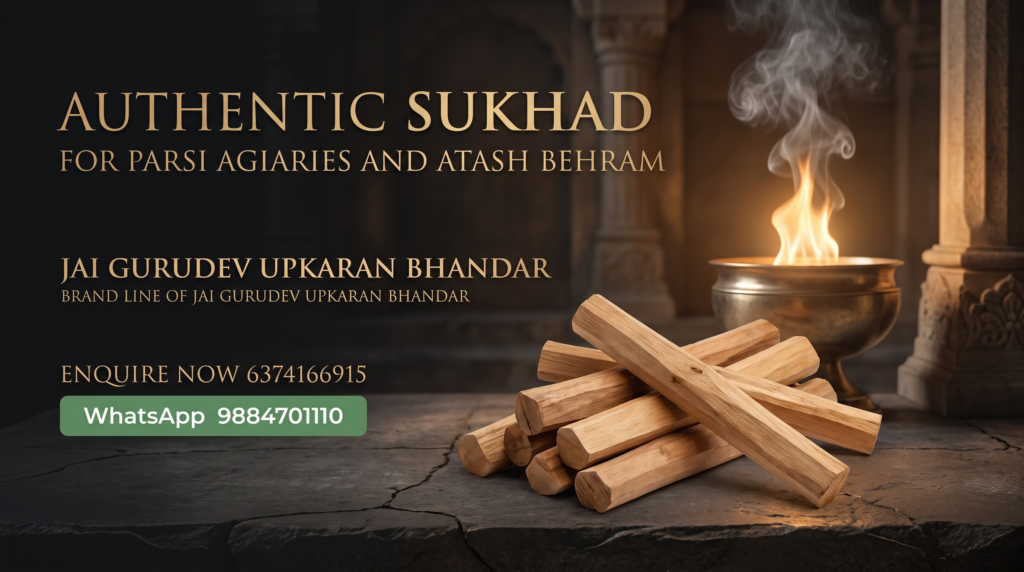
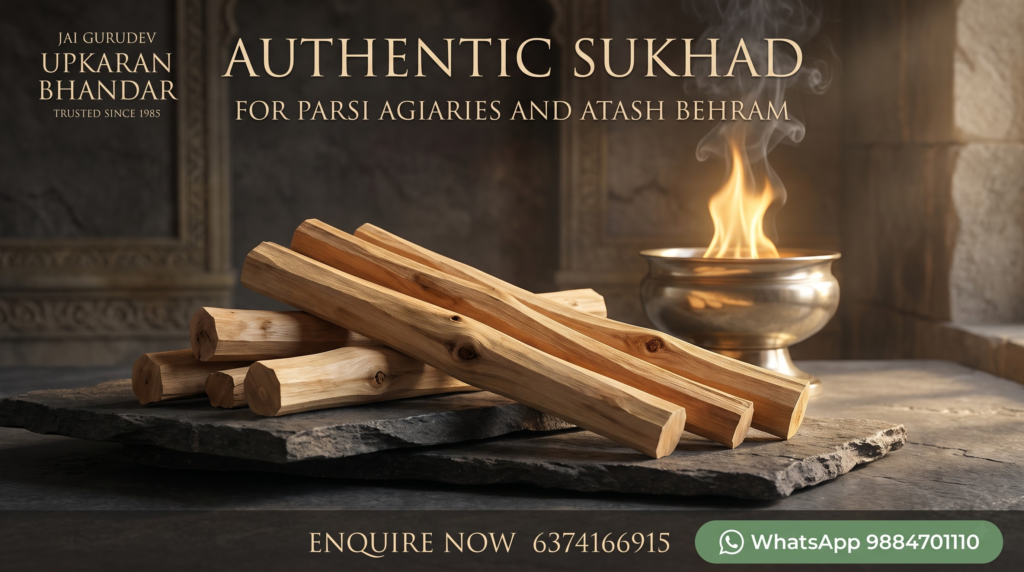
| Cut sticks (batti) | Heartwood cut to a set length and rough thickness | General offering use by worshippers | Length, approximate thickness, quantity |
| Machi-length sticks | Longer, straight, sound sticks for formal arrangement | Institutional use where a machi is built | Exact length, thickness, straightness, sound unsplit pieces, piece count |
| Chips / cut pieces | Small irregular heartwood pieces | Smaller offerings; economical general use | Approximate size range, heartwood content |
| Powder | Finely ground heartwood | Household and non-fire uses | Fineness, heartwood content, absence of fillers |
| Billets / logs | Larger unworked heartwood pieces | Buyers cutting to their own specification | Approximate size, soundness |
The distinction that matters most in a Zoroastrian context is between ordinary cut sticks and machi-length sticks. A machi is an arrangement built in the shape of a throne from roughly six to nine substantial sticks — community sources describe them commonly in the eight-to-ten-inch range, with eighteen inches cited at Iranshah in Udvada, and the number varying by institution. That is a dimensional specification, and chips cannot satisfy it however good they are.
If you take one practical point from this article, take this one: state the length. It is the most frequently omitted detail in this trade and the most expensive to get wrong.
Trade Terminology You Will Meet
| Term | What it means |
| Santalum album | Indian sandalwood — the species behind genuine Sukhad |
| Sukhad | Gujarati for sandalwood; in Parsi use, sandalwood for the sacred fire |
| Chandan | Hindi and Sanskrit-derived word for sandalwood |
| Srigandha | Kannada word for sandalwood |
| Mysore sandalwood | A commercial designation reflecting Karnataka’s historic centrality to the trade |
| Heartwood | The dense, fragrant inner wood — the part worth buying |
| Sapwood | The pale outer wood, carrying little fragrance |
| Hemiparasite | A plant that photosynthesises but also draws nutrients from host plants’ roots |
| Billet | A short unworked length of heartwood, cut down from a log |
| Seasoning | Controlled drying of the wood |
| Santalol | The principal aromatic constituent group of sandalwood oil |
| Red sandalwood | Pterocarpus santalinus — a different genus, valued for colour, not fragrance |
That last row prevents a recurring and entirely avoidable mix-up. Red sandalwood is a real and valuable wood used widely for carving and religious articles. It is not aromatic and it is not Sukhad.
What “Pure” Adds to “Sandalwood”
In this market, “pure” is doing four specific jobs:
- Species — it is Santalum album, not another sandalwood and not an unrelated wood sold under the name.
- Part of the tree — it is heartwood, not sapwood, bark or dust.
- Nothing added — no sprayed fragrance, no surface oil, no dye, stain or polish.
- Nothing removed — the wood has not been through oil extraction and sold on as spent material.
A seller who uses the word should be able to confirm all four when asked plainly. If you want to test whether the material lives up to the claim, the companion article on identifying authentic Sukhad sets out the physical checks.
Which Form Suits Which Requirement
- An individual making an offering at a fire temple. Cut sticks or chips of genuine heartwood. Small quantity, bought where convenient, checked for genuine fragrance.
- A family arranging a ceremony at home. Cut sticks or chips, bought a little ahead of the date, stored closed and away from other scents. Community sources describe sandalwood being offered to the ceremonial fire at a jashan, with loban placed on the fire afterwards.
- An agiary with a recurring requirement. A written specification covering form, size and quantity, sourced consistently so that consignments match one another.
- An institution that builds a machi. Machi-length sticks to an exact specification: length, thickness, straightness, soundness and piece count. This is the least forgiving requirement in the category.
- A household using sandalwood for non-fire purposes. Powder, bought from a source already proven on sticks, since powder is easier to adulterate and harder to inspect.
Why Indian Sandalwood Is Valued Above Other Sandalwoods
Three reasons, all of them factual rather than promotional.
Oil composition. The santalol share of Indian sandalwood oil is far higher than in other commercial sandalwood species, and santalol is what the fragrance is.
Long-established use. Santalum album is the sandalwood embedded in Indian religious and cultural practice, and the vocabulary of the trade grew up around it.
Scarcity. The species has been listed as vulnerable on the IUCN Red List since the late 1990s, and recorded Indian production fell from roughly 4,000 tonnes a year in the 1960s to a few hundred tonnes a year by the 2010s. Regulation of harvesting and movement remains substantial, even after states such as Karnataka liberalised private cultivation from 2001 onwards, including through a 2022 state sandalwood policy.
Scarcity is not a virtue of the product, but it is a fact about the product, and it explains both the price and the incentive to substitute.
Sandalwood Oil and Sandalwood Wood Are Two Markets
Buyers of Sukhad are competing, indirectly, with an industry most of them never think about.
Sandalwood heartwood has two destinations. It can be sold as wood — for religious use, carving and craft — or it can be distilled for its essential oil, which is used in fine fragrance. Published figures place sandalwood heartwood at around a hundred US dollars a kilogram, while sandalwood oil has been quoted in the region of 1,750 to 2,500 US dollars a kilogram. Since oil yield from heartwood is measured in low single-digit percentages, the two uses end up bidding against each other for the same limited material.
Three consequences reach the Sukhad buyer directly.
The best material is pulled towards distillation. Oil-rich heartwood, and root wood especially, is worth more in a still than on a shelf. That is not a conspiracy; it is arithmetic.
Spent wood re-enters the market. Wood from which oil has already been extracted still looks like sandalwood. It smells thin and hollow because most of what made it valuable has been removed. It is one of the substitutes a buyer should know exists.
Global fragrance demand moves local religious prices. When international demand for sandalwood oil rises, the price of the wood that Sukhad is cut from rises with it, regardless of what is happening in any temple town.
This is worth understanding because it reframes price conversations. A supplier quoting more than you expected is usually not exploiting a religious requirement; they are buying in a market where perfumery is the competing bidder.
What Happens to Sukhad Between Purchase and Use
Sandalwood is bought for a volatile substance held inside a piece of wood, and volatile means exactly what it sounds like. Understanding how fragrance is lost explains every storage rule worth following.
Air takes it. Aromatic compounds evaporate from exposed surfaces continuously. A closed container slows this dramatically; an open shelf does not.
Surface area accelerates it. A billet has very little surface relative to its mass. Powder has an enormous amount. That is why powder smells wonderful when opened and fades far sooner than sticks of identical origin — nothing is wrong with it, it simply has more exposed surface.
Heat accelerates it. Warmth drives evaporation. A store room under a hot roof is the worst place in a building for sandalwood.
Light degrades it. Direct sunlight is best avoided entirely.
Humidity works in both directions. Dry wood reabsorbs atmospheric moisture, which matters enormously for material that must be thoroughly dry before use. In coastal cities during monsoon months, this can undo months of careful seasoning in weeks.
Neighbouring smells transfer. Wood is porous. Camphor, incense, perfumed soaps, cleaning chemicals and foodstuffs all leave their mark on sandalwood stored beside them, and the contamination cannot be removed afterwards.
The practical conclusion is unglamorous: cool, dark, dry, closed, isolated from other scents, and rotated so older stock is used first. An institution that stores well can buy in larger, less frequent quantities; one that cannot should buy smaller and more often, whatever the bulk rate looks like.
Weight, Piece Count and How to Avoid Ordering the Wrong Amount
Sandalwood is usually sold by weight, but a machi is built from a number of pieces of a given length. Those two units do not convert reliably, because the weight of a stick depends on its thickness and density as well as its length.
The practical answer is to state both and let the supplier reconcile them:
- State the piece count and the size — for example, sixty sticks of nine inches, roughly finger-thickness.
- State the weight if you have a budget or a storage limit — and say which of the two takes priority if they cannot both be met.
- Ask the supplier to confirm the expected piece count for the weight quoted, before dispatch.
- Check both on arrival. A consignment can be correct by weight and short by piece count if the sticks are thicker than expected.
Institutions that record both figures for each consignment build up a reliable local conversion within two or three orders, which makes every subsequent enquiry straightforward.
What the Fire Actually Requires From the Material
The requirements are few and they are strict, and every one traces back to where the material ends up.
Dryness. Community guidance on what is offered to the sacred fire is consistent and emphatic; descriptions reach for words like bone-dry, and the ordinary fuel wood used in fire temples is likewise chosen for low moisture. Damp wood smokes and spits.
Cleanliness. The material goes onto a consecrated fire in an enclosed sanctum, handled by a priest using implements. Dust, grit, mould and contamination from storage all disqualify it.
Correct size. Where an arrangement is built, size is not a preference.
Nothing applied. Sprayed fragrance and surface treatments have no place on material destined for a sacred fire, quite apart from what they do to the smell when burned.
Soundness. Split, crumbling or insect-damaged pieces are not usable in an arrangement and reflect poor storage somewhere in the chain.
Three Product Myths Worth Retiring
“Sandalwood improves with age.” It does not. Properly seasoned wood is the goal, and once that point is reached, time only removes fragrance. The comparison people reach for — wine, whisky, aged timber for instruments — does not apply, because what is being valued here is a volatile oil that leaves the wood steadily. Buy for use, store carefully, rotate stock.
“Thicker sticks are better sticks.” Thickness is a functional choice, not a quality grade. Thicker pieces burn longer and release fragrance more slowly; thinner pieces do the opposite. Where an arrangement is built, thickness matters because the arrangement has to hold together. Neither is evidence about heartwood content, dryness or species — which are the things that actually determine quality.
“If it is from Karnataka, it is Mysore sandalwood, so it is the best.” Karnataka’s historic centrality to the trade is real, and the designation grew out of it. But origin describes where material came from, not what condition it is in. A poorly seasoned, sapwood-heavy consignment from a celebrated region is worse than well-prepared heartwood from anywhere else. Judge the material in front of you; treat origin as context rather than as a guarantee.
A fourth belief is worth mentioning because it causes real disappointment: that there is a single correct product called “Sukhad” which every seller either has or does not have. There is not. There is a species, a part of the tree, a form and a size — and the combination that is right for a worshipper’s small offering is not the combination that is right for an institution building a machi.
Specifying the Product Properly
A usable specification fits in a few lines:
- Species: Indian sandalwood, Santalum album
- Form: cut sticks / machi-length sticks / chips / powder / billets
- Length and approximate thickness, where sticks are required
- Piece count, where an arrangement is built
- Quantity, by weight and by piece count where both matter
- Packing requirement
- Delivery address with PIN code, and a contact number
- Date required
Write it once, reuse it, and attach it to every enquiry. It makes quotations comparable, it makes deviations visible, and it survives a change of the person doing the buying — which in an institution is the point.
People Also Ask About Sandalwood Sukhad
What is sandalwood Sukhad?
The fragrant heartwood of the Indian sandalwood tree, Santalum album, prepared for religious use. Sukhad is the Gujarati word for sandalwood.
Which part of the sandalwood tree is used?
The heartwood, and root wood where available. The pale outer sapwood carries very little fragrance.
Why is sandalwood so slow to grow?
It is a hemiparasite dependent on host plants, and the valuable heartwood only begins forming around the seventh year, accumulating oil over decades.
Is Mysore sandalwood a different species?
No. It is a commercial designation reflecting Karnataka’s historic centrality to the Indian sandalwood trade, not a separate species.
What is a billet?
A short unworked length of heartwood, cut down from a log, from which sticks and chips are produced.
What does seasoning mean?
Controlled drying of the wood. It takes time and cannot be rushed without trapping moisture or damaging the material.
Why do cut sticks cost more than chips?
Long, straight, sound sticks require larger sound billets and generate more waste during cutting. Chips are, in part, what is left over.
Is red sandalwood a type of Sukhad?
No. Red sandalwood is Pterocarpus santalinus, a different genus, valued for its colour rather than any fragrance.
Frequently Asked Questions
How can I tell heartwood from sapwood by eye?
Sapwood is distinctly paler and lighter in weight, and on a cut end the boundary between the two zones is often visible. Seeing both once makes the distinction permanent.
Does sandalwood oil content vary much between trees?
Considerably. Published surveys record heartwood oil percentages ranging from well under one per cent to over four per cent, with a meaningful share of trees carrying little or no heartwood even after twenty years.
Is powdered sandalwood lower quality than sticks?
Not necessarily, but it is harder to inspect, easier to adulterate and impossible to use where an arrangement requires sticks. Buy powder from a source already proven on sticks.
What size sticks should an institution order?
Whatever the institution’s own practice requires. Community sources describe machi sticks commonly in the eight-to-ten-inch range, with eighteen inches cited at one Atash Behram, and the piece count varying by institution — so the institution’s own figure is the only one that counts.
Does sandalwood from a particular state smell different?
Origin, growing conditions, tree age and heartwood quality all affect the oil, and trade designations such as Mysore sandalwood exist for that reason. Judging a specific consignment by its stated origin alone is unwise; judge the material.
Can sandalwood be cultivated legally by private growers?
Legal reform has progressively allowed private cultivation and sale in states including Karnataka, from 2001 onwards and notably through its 2022 sandalwood policy, though harvesting, transit and marketing permissions remain subject to forest department control. Rules differ by state and change over time, so current local advice is essential.
Why is sandalwood uprooted rather than cut at the base?
Because the root wood is notably rich in oil. Leaving it in the ground would discard some of the most valuable material.
Is sandalwood dust the same as sandalwood powder?
Not in practice. Powder implies ground heartwood; dust and fines are cutting by-products and sit at the bottom of the quality range. Ask which you are being offered.
Is there a standard grading system for sandalwood?
The trade uses grading language, but it is commercial rather than statutory and it varies between sellers. A written physical specification is far more reliable than a grade name.
Does the form of the wood change the fragrance?
The fragrance is the same material, but surface area changes how quickly it is released. Finer material gives up its fragrance faster and loses it sooner in storage.
How long does sandalwood keep?
It does not spoil, but fragrance weakens over time and much faster in heat, light, open air or humidity. Storage conditions matter far more than age.
Can I ask a supplier for a particular part of the tree?
You can ask, and the answer is informative. Heartwood is the reasonable expectation; root-derived material is prized; sapwood content is the thing to ask about specifically.
Conclusion
Once the product is clear, most of this market stops being mysterious. Sandalwood is a slow, host-dependent tree whose value sits in the heartwood it takes years to make. That heartwood is separated, cut, seasoned, sorted and packed, and each of those steps shows up in what you are quoted. What you receive — sticks, machi lengths, chips, powder or billets — is a choice, and for Zoroastrian use it is a choice with a right answer determined by how the material will be used.
Get the vocabulary right and your enquiry becomes specific. Get the form and size right and the consignment becomes usable. Everything else is verification, which the companion article on authentic Sukhad covers in full.
A Note for Readers With a Sukhad Requirement
This article is written to explain the product rather than to sell it. If you do have a Sukhad or sandalwood requirement, Jai Gurudev Upkaran Bhandar in Chennai accepts enquiries and can discuss suitable sandalwood options, forms, current availability and PAN India delivery assistance.
Call: +91 63741 66915
WhatsApp: +91 98847 01110
Contact Jai Gurudev Upkaran Bhandar
JAI GURUDEV UPKARAN BHANDAR
Premium Sandalwood Supplier in Chennai, Tamil Nadu, India
Contact Details
Phone: +91 63741 66915
WhatsApp: +91 98847 01110
Enquiry Hours: 24×7 for urgent and emergency sandalwood requirements
Business Address
Jai Gurudev Upkaran Bhandar
136, Amman Koil Street, Sowcarpet, Chennai – 600001, Tamil Nadu, India
Connect With Us
WhatsApp: https://wa.me/919884701110
Instagram: https://www.instagram.com/jai_gurudev_upkaran_bhandar
Facebook: https://www.facebook.com/share/1XYnyFYKR8/?mibextid=wwXIfr
LinkedIn: https://www.linkedin.com/in/jai-gurudev-upkaran-bhandar-0b76b93b5
Customer Support
For product enquiries, pricing, availability, bulk requirements, temple requirements, religious-institution requirements, Sukhad requirements, funeral or emergency sandalwood requirements, and PAN India delivery assistance, contact us by phone or WhatsApp.
Emergency Requirement? Call or WhatsApp us 24×7.