Contents
- 1 Pure Sukhad for Agiaries and Zoroastrian Fire Temples in India
- 1.1 What This Guide Covers
- 1.2 What Is Sukhad?
- 1.3 Where Sukhad Fits in Zoroastrian Fire Temple Practice
- 1.4 Who Offers Sukhad, and How
- 1.5 What “Pure” Means When You Are Buying Sukhad
- 1.6 The Forms Sukhad Is Supplied In
- 1.7 Who Buys Sukhad, and What Each Buyer Typically Needs
- 1.8 What Sukhad Costs, and Why Quoted Prices Vary So Much
- 1.9 Why Genuine Sukhad Has Become Harder to Buy
- 1.10 Quality Checklist for Institutional Buyers
- 1.11 Availability, Packaging and Delivery Across India
- 1.12 Storage and Handling
- 1.13 Common Mistakes When Buying Sukhad
- 1.14 About Jai Gurudev Upkaran Bhandar
- 1.15 People Also Ask About Pure Sukhad
- 1.16 Frequently Asked Questions
- 1.17 Conclusion
- 1.18 Need Pure Sukhad for Religious or Institutional Use?
- 1.19 Contact Jai Gurudev Upkaran Bhandar
Pure Sukhad for Agiaries and Zoroastrian Fire Temples in India
Direct Answer
Sukhad is the Gujarati word for sandalwood, and among Parsi and Zoroastrian communities it refers to the fragrant sandalwood offered to the consecrated fire in an agiary or Atash Behram. Pure Sukhad means genuine sandalwood heartwood — dry, naturally aromatic, and free of dye, perfume or substitute timber. Quality is judged by heartwood content, dryness and natural fragrance.
What This Guide Covers
Sukhad sits at an unusual junction. It is a religious offering with centuries of tradition behind it, and at the same time it is a commodity traded in a market that has become expensive, tightly regulated and, in places, dishonest. A person buying a small packet for a personal visit and a trustee arranging a standing supply for an agiary are asking the same first question: is this actually sandalwood, and is it good enough?
This guide answers that question from both directions. It explains the religious setting carefully and without inventing detail, then sets out the practical tests, product forms, supply realities and supplier questions that decide whether a particular consignment is worth buying. Where a topic deserves more depth than a single page allows, you will find a link to a dedicated article.
A note on sources and limits before we begin. Zoroastrianism is a living religion with real institutional variation. Practices differ between an Atash Behram and a smaller agiary, between cities, and according to the guidance of the priests who serve a particular fire. Nothing in this article should be read as a ruling on religious practice. Where community practice varies, this guide says so rather than flattening it into a single rule.
What Is Sukhad?
Is Sukhad the same as sandalwood?
Yes. Sukhad is simply the Gujarati word for sandalwood, and because the Parsi community in India has been Gujarati-speaking for centuries, it is the word that has stayed in use for the sandalwood offered at fire temples. When a Parsi buyer asks for Sukhad, they are asking for sandalwood. When the same buyer speaks to a trader in a Chennai or Bengaluru market, the word used may be chandan, srigandha or simply sandalwood, and the material being discussed is the same species.
The word carries a specific connotation, though, that plain “sandalwood” does not. Sukhad is understood as sandalwood intended for the sacred fire. That expectation quietly raises the bar on quality. Sandalwood sold for carving can be valued for grain and block size. Sandalwood sold as Sukhad is valued for fragrance, dryness and cleanliness, because it is going to be burned in a consecrated setting.
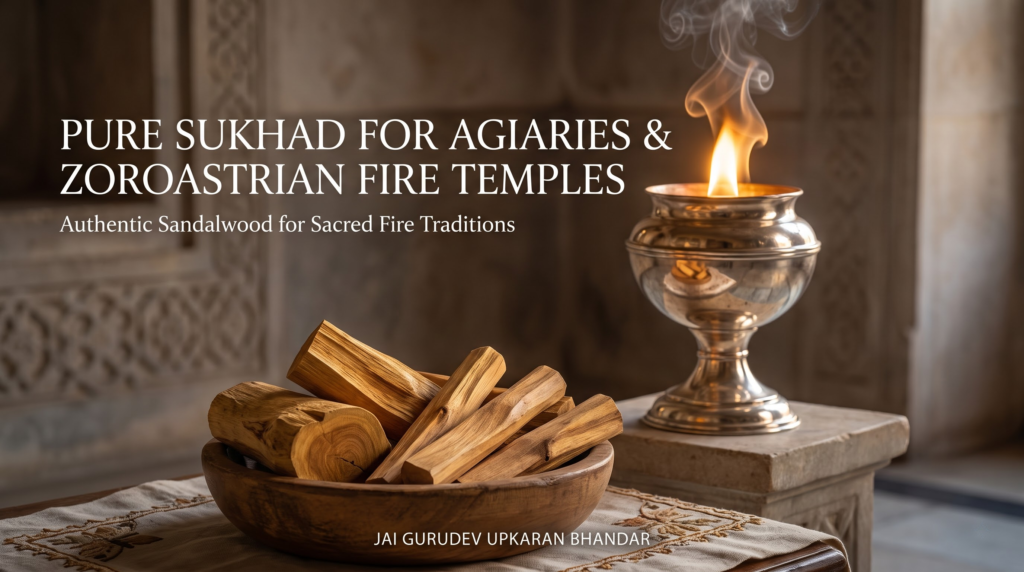
Sukhad, sukhar, chandan: how the terms relate
You will see several spellings and related words in circulation, and none of them describe different products:
- Sukhad — the standard Gujarati term, and the one most Parsi buyers use.
- Sukhar — a variant spelling encountered in some transliterations and older writing.
- Chandan — the Hindi and Sanskrit-derived word used across most of India, including by traders.
- Srigandha — the Kannada term, common in Karnataka, historically the centre of the Indian sandalwood trade.
- Santalum album — the botanical name of Indian sandalwood, the species behind all of the above.
Knowing these words is practically useful. A supplier who deals mainly with Hindu temples may not immediately recognise “Sukhad,” and a buyer who only uses “Sukhad” may be told a product is unavailable when it is sitting on the shelf under another name.
Where Sukhad Fits in Zoroastrian Fire Temple Practice
The fire is tended, not merely lit
In a Zoroastrian fire temple, the fire in the sanctum is consecrated and is kept burning continuously. It is fed with fuel by priests according to a fixed daily rhythm. Sandalwood is not the bulk fuel that keeps it alive — dry, clean, low-moisture logs of ordinary wood do most of that work, with babul (baval) commonly mentioned in community writing. Sandalwood is the fragrant offering placed on the fire, and its purpose is bound up with fragrance rather than heat.
That distinction matters commercially. A fire temple’s ordinary fuel requirement and its Sukhad requirement are two different purchases, with different quality criteria and very different price points.
The three grades of consecrated fire
Zoroastrian tradition recognises three grades of consecrated fire, distinguished by how elaborately they are consecrated rather than by anything visible in the flame.
| Grade | Position | Consecration, in general terms |
| Atash Dadgah | The simplest grade | The least elaborate consecration; in the absence of services a lay person may tend it |
| Atash Adaran | Middle grade | Consecrated from hearth fires representing four traditional occupational groups, with extended liturgical services |
| Atash Behram | The highest grade | Consecrated from sixteen sources of fire, with a very large number of liturgical services conducted over a long period |
Atash Behrams are few. Published community lists commonly count eight in India — at Udvada, Navsari, two in Surat and four in Mumbai — with one more at Yazd in Iran. Agiaries housing an Adaran or Dadgah fire are far more numerous; India holds the large majority of the world’s fire temples.
“Agiary” and “Atash Behram” are not interchangeable
This is worth stating plainly because commercial content gets it wrong constantly. Agiary — also written agiari or agiyari — is a Gujarati word for a fire temple, a house of fire. Atash Behram is a specific grade of consecrated fire, and by extension the institution that houses one. An agiary most often houses an Adaran fire. Every Atash Behram is a fire temple; not every fire temple is an Atash Behram.
Other words you may encounter for the same kind of institution include dar-e Mehr (or darb-e Mehr), atashkadeh and atashgah, reflecting Persian usage alongside the Gujarati.
For a supplier, the practical consequence is simple: do not assume that what one institution requests is what another will request. Ask.
The boi ceremony
The daily tending of the consecrated fire is known as the boi ceremony. The word itself comes from older Iranian words meaning fragrance, which tells you how central the aromatic offering is to the ritual’s identity. Over Adaran and Atash Behram fires the ceremony is performed in each of the five watches of the day; over a Dadgah fire it is performed less frequently. A bell is rung during the accompanying prayers, and the officiating priest afterwards distributes sacred ash to those present.
Priests attending the fire cover the mouth and nose with a cloth mask and handle offerings with implements rather than by hand, so that the fire is not touched by breath or by direct contact.
The machi
At specific times, sandalwood is offered in a formal arrangement known as a machi — lengths of sandalwood placed in the shape of a throne for the fire. Community sources describe machi as being built from roughly six to nine substantial sandalwood sticks, and the number varies by institution: nine at Iranshah in Udvada, seven at one Mumbai Atash Behram, six at others. The sticks are substantial, commonly described in the range of eight to ten inches, with eighteen inches cited for Iranshah.
This has a direct bearing on procurement, and it is the single most commonly missed point in sandalwood buying for fire temples: machi requires long, straight, sound sticks of consistent length, not chips or offcuts. An institution ordering Sukhad for machi is buying to a dimensional specification, and a supplier who does not ask about length is not going to deliver the right product.
Who Offers Sukhad, and How
Two quite different patterns of offering exist side by side, and they generate two different kinds of demand.
Lay offerings. Individuals visiting a fire temple may offer sandalwood to the fire. Community guidance describes devotees offering fragrant sandalwood, which the fire returns as fragrance — a symbolism often connected to the Zoroastrian emphasis on good thoughts, good words and good deeds. Purchases here are small: a few sticks, a modest packet, often bought at or near the temple itself.
Institutional requirements. The fire must be tended every day, in every watch, without interruption. That produces steady, predictable, year-round demand for both ordinary fuel wood and sandalwood, managed by trustees, managing committees or appointed staff rather than by individuals. This is where sourcing, price, consistency and reliability of supply actually matter.
A necessary caution for buyers and suppliers alike: entry to Indian fire temples is restricted to Zoroastrians, and this restriction is taken seriously. A supplier who is not Zoroastrian will not be entering the sanctum, will not be handling the fire, and should not expect or request access. The commercial relationship ends at delivery. Photography and recording inside these spaces are likewise governed by each institution’s rules, and those rules deserve respect rather than negotiation.
What “Pure” Means When You Are Buying Sukhad
“Pure Sukhad” is used loosely in the market. Reduced to what a buyer can actually check, it means four things.
1. It is heartwood, not sapwood
A sandalwood tree does not produce fragrant wood throughout. The aromatic material is the heartwood — the dense, darker-toned inner wood that forms as the tree matures. Published research places the onset of heartwood formation at around the seventh year of growth, with oil content rising substantially in mature trees, and notes that a meaningful proportion of trees show little or no heartwood even after two decades. The outer sapwood is pale, comparatively soft and carries very little fragrance.
Sapwood sold as Sukhad is not a fake in the strict sense — it genuinely comes from a sandalwood tree — but it is a poor offering and a poor use of money. Pale, light, weakly scented sticks are the visible symptom.
2. It is dry
Community guidance on what is offered to the fire is consistent and emphatic on this point: the wood should be thoroughly dry. Descriptions of suitable offerings use words like “bone-dry,” and the everyday fuel wood chosen for fire temples is likewise chosen for low moisture content. Damp wood smokes, spits, burns poorly and behaves badly in a setting where that is unacceptable.
Dryness is also the quality most easily lost after purchase. Wood that arrives properly seasoned can pick up moisture in a humid store room within weeks.
3. Its fragrance is its own
This is where the market has a genuine, documented problem. Zoroastrian community writing has described inferior wood being cut into sandalwood-sized sticks, sealed in plastic bags and sprayed with cheap perfume — with the reported result that the scent is strong when the bag is opened and gone shortly afterwards. The deception is designed for the point of sale, not for the fire.
Genuine sandalwood fragrance is not applied. It lives in the oil held inside the heartwood, dominated by alpha- and beta-santalols, which account for roughly two-thirds to four-fifths of the essential oil in Indian sandalwood. It is milky, soft, persistent and released steadily by fresh cut or by heat.
4. It has not been coloured or dressed up
Dye, stain, varnish and oil applied to the surface all have one purpose: to make cheap wood look like expensive wood. None of them belongs anywhere near material destined for a consecrated fire.
| Signal | Genuine Sukhad | Adulterated or substituted |
| Weight | Noticeably dense for its size | Light, feels like ordinary timber |
| Colour | Warm pale gold to light brown, natural variation | Uniform, sometimes obviously stained |
| Scent at rest | Soft, present, steady | Absent, or a sharp perfume note |
| Scent after a fresh scrape | Stronger, milky, unmistakable | Nothing beneath the surface |
| Scent over time | Persists for a long period | Fades quickly after the packet is opened |
| Surface | Fine, close grain | Open or fibrous grain, sometimes coated |
None of these tests is conclusive on its own. Together they are reliable enough for practical buying, and they cost nothing.
The Forms Sukhad Is Supplied In
| Form | Typical description | Commonly requested for |
| Sticks / batti | Cut lengths of heartwood, sized to order | Offering to the fire; machi arrangements where length and straightness matter |
| Chips / cut pieces | Small irregular heartwood pieces | General offering use; smaller personal purchases |
| Powder | Finely ground heartwood | Non-fire uses; often bought by households alongside Sukhad |
| Logs / billets | Larger unworked heartwood pieces | Buyers who cut to their own specification |
| Bark and waste grades | Low-heartwood material | Not appropriate as a fragrant offering |
If an institution has a machi specification, the length and thickness of the stick is the order detail that matters most. Stating it at the enquiry stage prevents the most common and most expensive mismatch in this trade.
Who Buys Sukhad, and What Each Buyer Typically Needs
Not every Sukhad requirement is the same requirement, and confusing them is the root of most unsatisfactory purchases.
| Buyer | Typical quantity | What usually matters most |
| Individual visiting a fire temple | Very small, often bought on the day | Convenience, genuine fragrance, small packet sizes |
| Family marking an occasion | Small to moderate, bought in advance | Presentation, reliability of the date, consistent quality |
| Agiary trustee or managing committee | Recurring, planned | Consistent grade, dependable dispatch, predictable supply |
| Atash Behram administration | Recurring, with dimensional requirements | Stick length and straightness, sound unbroken pieces, consistency |
| Anjuman or community association | Periodic, sometimes bulk | Quantity, fair pricing, transparent description |
| Family sending Sukhad to relatives in India | Small, dispatched to a third address | Packaging, accurate delivery information, realistic timelines |
The buyer whose needs are most often misunderstood is the institutional one. An individual can accept whatever the shop has today. An institution cannot, because it needs the same thing again next month and the month after. What an institution is really buying is not a consignment but a repeatable specification — and specifications only stay repeatable if they were written down in the first place.
The second most misunderstood buyer is the overseas family member arranging a delivery in India. Here almost everything depends on information that only the buyer holds: the correct delivery address, a working local phone number, and a realistic date. A supplier can control stock and dispatch; nobody can control a wrong PIN code.
What Sukhad Costs, and Why Quoted Prices Vary So Much
There is no single price for Sukhad, and any page that gives you one figure should be treated carefully. What can be said honestly is why the spread is so wide.
Writing within the Zoroastrian community over the past two decades has reported a very broad range of prices for sandalwood bought for religious use — figures in the region of a few hundred rupees a kilogram at the low end, and several thousand rupees a kilogram for material described as high quality, with premium Mysore-origin sandalwood quoted higher still. Those figures are historical reports from community discussion, not current quotations, and they should be read as an illustration of spread rather than as a price list.
Four things drive the difference:
- Heartwood content. Material that is largely sapwood is cheap to produce and cheap to sell, and it is the main reason a low quotation is possible at all.
- Form and size. Long, straight, sound sticks cut to a fixed length waste more raw material than chips do, and they cost accordingly. Chips and offcuts are the cheapest usable form.
- Origin and legality. Legally sourced, documented material carries costs that undocumented material does not.
- Market conditions on the day. Sandalwood availability genuinely fluctuates, and quotations follow it.
The practical conclusion is not that expensive is always better. It is that a price far below the prevailing market is telling you something specific about heartwood content, form or origin — and it is worth asking which.
Why Genuine Sukhad Has Become Harder to Buy
Buyers who remember earlier decades often assume they are being overcharged. Usually they are running into a genuine structural shortage.
- The species is under pressure. Santalum album has been listed as vulnerable on the IUCN Red List since the late 1990s.
- Output collapsed. Recorded Indian production fell from roughly 4,000 tonnes a year in the 1960s to a few hundred tonnes a year by the 2010s.
- The tree is slow. Heartwood — the only part worth buying — takes many years to form, and a meaningful share of trees disappoint even after twenty years.
- The trade is regulated. Legal reform in Karnataka since 2001, including a 2022 state sandalwood policy, has progressively allowed private cultivation and open-market sale, but forest department control over harvesting, transit and marketing permissions remains a real feature of the trade.
- Price followed. Community writing has recorded steep price escalation for good sandalwood over the past two decades, and price pressure is precisely what creates a market for perfumed substitutes.
Understanding this changes how you buy. It explains why an unusually cheap offer should raise suspicion rather than enthusiasm, and why availability genuinely fluctuates instead of being a sales tactic.
Quality Checklist for Institutional Buyers
- Confirm the product is heartwood and ask what proportion of sapwood, if any, is present.
- State the form required — stick, chip, powder or log — and do not leave it implied.
- State stick length and approximate thickness where machi or a fixed arrangement is involved.
- Ask how the material has been dried and how long it has been in store.
- Ask specifically whether anything has been applied to the wood: perfume, oil, dye or coating.
- Request a sample before a first large order, and test it by scent and by weight.
- Ask for a consistent grade to be held for repeat supply rather than buying opportunistically.
- Confirm packaging suited to your storage conditions.
- Confirm the realistic dispatch window for your quantity and destination.
- Where your institution has its own preference or long-standing arrangement, treat that as the governing requirement.
That last point deserves emphasis. Fire temples are not uniform, and some have specific expectations about what is offered at their fire and where it comes from. Community discussion has at times been sharp on exactly this question. The correct order of operations is to ask the institution first and buy second.
Availability, Packaging and Delivery Across India
India’s Zoroastrian population is small and unevenly distributed. Official census figures recorded 69,601 Parsis in 2001 and 57,264 in 2011. Mumbai holds the largest concentration of fire temples by a wide margin, with significant historical presences in Gujarat — Udvada, Navsari, Surat, and other towns — and established communities in Hyderabad and Secunderabad, Delhi, Pune, Bengaluru, Kolkata and Chennai. Chennai’s fire temple, the Jal Phiroj Clubwala Dar-e Meher at Royapuram, was consecrated in 1910 and is managed by the Madras Parsi Zarthosti Anjuman; published sources describe it as the only Parsi fire temple in Tamil Nadu and the surrounding region.
For a supplier, that geography means most consignments travel. Practical consequences worth setting out honestly:
Availability and delivery time depend on current stock, destination, PIN code, required quantity, product form, transport availability, courier services and local logistics.
Packaging deserves attention rather than being an afterthought. Sandalwood is bought for fragrance, and fragrance is lost to open air and gained, wrongly, from whatever it is stored beside. Material should travel in clean packaging, protected from crushing, kept away from strongly scented goods, and be moved into proper storage on arrival rather than left in transit packing.
Storage and Handling
- Store in a cool, dry, dark place; heat and sunlight degrade aromatic material over time.
- Keep containers closed between uses so volatile oil is not lost to the air.
- Keep Sukhad well away from camphor, incense, perfumed goods, soaps, cleaning chemicals and foodstuffs, all of which transfer odour.
- Guard against humidity, particularly in coastal cities during monsoon months.
- Rotate stock so older material is used first.
- Handle with clean, dry hands and keep the storage area clean, as befits material intended for a consecrated fire.
Common Mistakes When Buying Sukhad
- Buying on price alone. In a market with a documented adulteration problem, an unusually low price is information, not a bargain.
- Judging by smell at the point of sale. That is exactly the test a perfumed substitute is engineered to pass.
- Not specifying the form. “Sandalwood” can mean five different products.
- Not specifying stick length. The most frequent cause of an unusable consignment.
- Ordering in bulk before sampling. A sample costs very little compared with a rejected consignment.
- Assuming every institution accepts the same thing. Ask first.
- Storing it badly. Good material can be spoiled in a few humid months.
- Assuming an expensive commercial grade is religiously required. Commercial grading and religious acceptability are separate questions, and only the institution can answer the second.
About Jai Gurudev Upkaran Bhandar
Jai Gurudev Upkaran Bhandar is a premium heritage sandalwood supplier based in Sowcarpet, Chennai, Tamil Nadu, assisting temples, religious institutions, organizations, families and individual buyers with sandalwood requirements across India. Established in 1977, the business works with sandalwood in its various forms and accepts enquiries for Sukhad and sandalwood requirements from religious institutions and individual buyers, including Parsi and Zoroastrian buyers seeking Sukhad for religious use.
The business makes no claim to religious endorsement, approval or affiliation with any Zoroastrian institution. What it offers is what a sandalwood specialist should offer: a clear description of the product, honest information on availability, and assistance with delivery.
People Also Ask About Pure Sukhad
What does Sukhad mean?
Sukhad is the Gujarati word for sandalwood. Among Parsi and Zoroastrian communities it refers specifically to sandalwood offered to the consecrated fire in a fire temple.
Is Sukhad the same as chandan?
Yes. Sukhad (Gujarati), chandan (Hindi) and srigandha (Kannada) all refer to sandalwood. Sukhad is the term used in the Parsi religious context.
What is an agiary?
An agiary is a Zoroastrian fire temple; the word is Gujarati and means a house of fire. Most agiaries house an Adaran-grade consecrated fire.
Is an agiary the same as an Atash Behram?
No. Atash Behram is the highest grade of consecrated fire and the institution housing it. An agiary usually houses an Adaran fire. Every Atash Behram is a fire temple, but not every fire temple is an Atash Behram.
Is sandalwood the main fuel in a fire temple?
No. Ordinary dry, clean, low-moisture wood does the bulk of the work of sustaining the fire. Sandalwood is the fragrant offering.
What is a machi?
A machi is a throne-shaped arrangement of substantial sandalwood sticks offered to the consecrated fire. Community sources describe six to nine sticks, with the number varying by institution.
Can non-Zoroastrians enter a fire temple?
No. In India, entry is restricted to Zoroastrians, and the restriction is observed strictly. Suppliers should not expect access.
How can I tell if Sukhad is genuine?
Check weight, grain, natural colour and — most usefully — whether the fragrance survives a fresh scrape and persists over weeks rather than fading soon after the packet is opened.
Frequently Asked Questions
Which species is genuine Sukhad?
Indian sandalwood, Santalum album. It is the species historically associated with the Indian sandalwood trade and the one buyers generally mean by pure Sukhad.
Why is the heartwood the only part that matters?
Fragrance comes from oil held in the heartwood. The outer sapwood is pale, lighter and carries very little scent, so it makes a poor offering regardless of what it is sold as.
Does darker wood mean better Sukhad?
Not reliably. Natural sandalwood heartwood varies from pale gold to light brown, and colour can be faked with stain. Weight and persistent natural fragrance are better indicators than shade.
Why does sandalwood cost so much now?
Because supply genuinely contracted. The species is classed as vulnerable, recorded Indian production fell sharply from mid-twentieth-century levels, heartwood takes many years to form, and the trade is regulated.
Is there such a thing as a religiously mandated grade of Sukhad?
Commercial grades are trade classifications, not religious ones. Whether a particular product is acceptable at a particular fire is a question for that institution and its priests.
What should an institution specify when ordering?
Form, stick length and thickness where relevant, approximate quantity, delivery city and PIN code, the date by which it is needed, and whether the requirement is one-off or recurring.
Can Sukhad be supplied for a recurring monthly requirement?
Standing requirements are common for institutions, and can generally be discussed with a supplier in advance so that a consistent grade is held. Actual fulfilment always depends on stock and current market conditions.
How much Sukhad does a fire temple need?
This varies enormously with the grade of fire, the institution’s practice and the volume of lay offerings. No general figure can be given honestly; the institution’s own records are the only reliable guide.
Does Sukhad expire?
It does not spoil like a perishable good, but fragrance weakens over time and much faster in heat, light, open air or humidity. Good storage matters more than age.
Can Sukhad be sent outside India?
Sandalwood is a regulated commodity and export is subject to prevailing law, documentation and the import rules of the destination country. Any overseas requirement should be discussed specifically rather than assumed.
Is powdered sandalwood the same product as Sukhad sticks?
Both are sandalwood, but they are bought for different purposes. Where sticks are required for an arrangement such as machi, powder is not a substitute.
Should I buy from the fire temple itself or from a supplier?
Many institutions make sandalwood available on site, and some have long-standing preferences about what is offered at their fire. Ask the institution first; buy externally only when that is acceptable to them.
What if my institution rejects the material I bought?
Ask what specifically was unacceptable — form, size, dryness, origin or grade — and take that answer back to your supplier. Most rejections are specification problems rather than authenticity problems.
What should I do if I suspect a consignment is adulterated?
Stop using it, keep the packaging, scrape a fresh surface and check whether fragrance is present beneath, and raise it with the seller immediately. Sprayed perfume becomes obvious within weeks.
Conclusion
Sukhad occupies a place that deserves care from everyone in the chain. For the Zoroastrian community it is a fragrant offering to a consecrated fire that has, in some cases, burned continuously for a very long time. For those supplying it, that should translate into plain description, honest grading and no claims that cannot be supported.
If you take three things from this guide, take these. Buy heartwood, dry, with its own fragrance. Specify form and size rather than leaving them to be guessed. And when an institution is involved, let the institution’s own requirement decide the purchase.
The nine articles linked below go considerably deeper into each theme touched on here.
Need Pure Sukhad for Religious or Institutional Use?
For current availability, suitable sandalwood options, pricing, product details and PAN India delivery assistance, contact Jai Gurudev Upkaran Bhandar in Chennai.
Call: +91 63741 66915
WhatsApp: +91 98847 01110
For urgent sandalwood requirements, enquiries are available 24×7.
Contact Jai Gurudev Upkaran Bhandar
JAI GURUDEV UPKARAN BHANDAR
Premium Sandalwood Supplier in Chennai, Tamil Nadu, India
Contact Details
Phone: +91 63741 66915
WhatsApp: +91 98847 01110
Enquiry Hours: 24×7 for urgent and emergency sandalwood requirements
Business Address
Jai Gurudev Upkaran Bhandar
136, Amman Koil Street, Sowcarpet, Chennai – 600001, Tamil Nadu, India
Connect With Us
WhatsApp: https://wa.me/919884701110
Instagram: https://www.instagram.com/jai_gurudev_upkaran_bhandar
Facebook: https://www.facebook.com/share/1XYnyFYKR8/?mibextid=wwXIfr
LinkedIn: https://www.linkedin.com/in/jai-gurudev-upkaran-bhandar-0b76b93b5
GOOGLE PROFILE –https://share.google/SUkESdF1D2vyY98vC
Customer Support
For product enquiries, pricing, availability, bulk requirements, temple requirements, religious-institution requirements, Sukhad requirements, funeral or emergency sandalwood requirements, and PAN India delivery assistance, contact us by phone or WhatsApp.
Emergency Requirement? Call or WhatsApp us 24×7.