
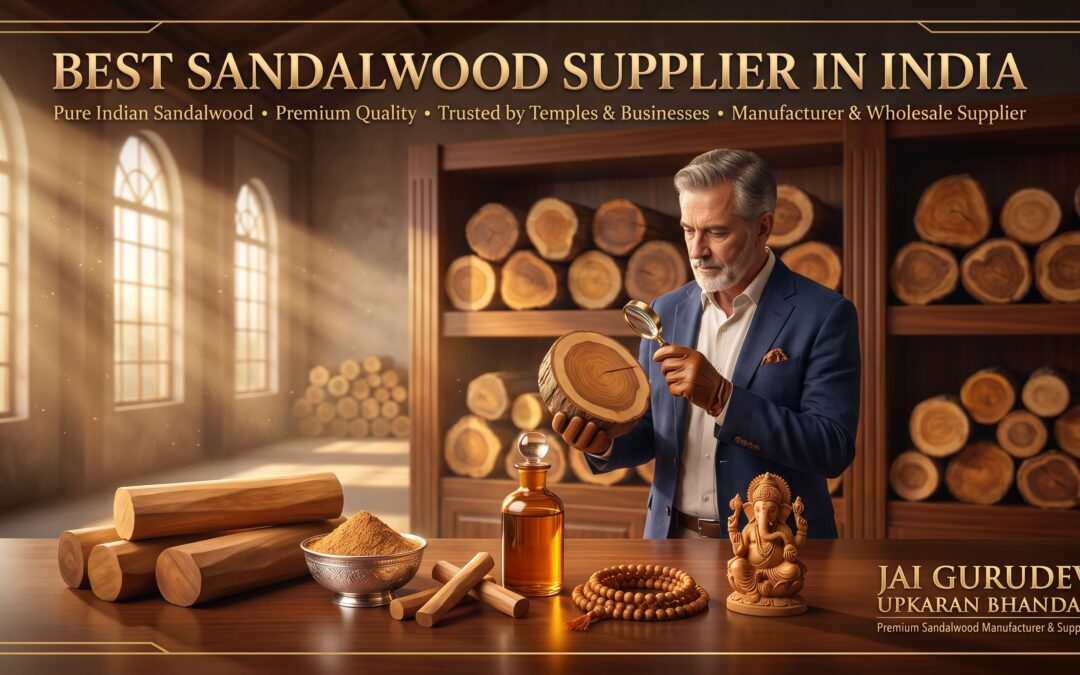
Quick answer: To choose the best bulk sandalwood supplier in India, follow ten steps: define your need, insist on genuine Santalum album, trace the source, demand legal papers, judge quality with a sample, assess the product range, confirm bulk capacity and MOQ, compare pricing fairly, evaluate delivery and reliability, and build a long-term relationship. Work through these in order and you will avoid fakes, legal risk, and bad deals. A supplier like Jai Gurudev Upkaran Bhandar — genuine Mysore-belt sandalwood, legal sourcing, full range, pan-India delivery — shows what a strong choice looks like.
Choosing a supplier is a decision, not a guess. This guide walks you through that decision step by step. Follow it in order, from knowing your own need to building a lasting supply line.
https://www.instagram.com/jai_gurudev_upkaran_bhandar?igsh=MWJ1NWoybnY5c3N1Yw==
https://www.facebook.com/share/1XYnyFYKR8/?mibextid=wwXIfr
www.linkedin.com/in/jai-gurudev-upkaran-bhandar-0b76b93b5
Contents
- 1 Why the Right Choice Matters So Much
- 2 Point 1: Define Your Need First
- 3 Point 2: Insist on Genuine Santalum album
- 4 Point 3: Trace the Source
- 5 Point 4: Demand Legal Documentation
- 6 Point 5: Judge Quality With a Sample
- 7 Point 6: Assess the Product Range
- 8 Point 7: Confirm Bulk Capacity and MOQ
- 9 Point 8: Compare Pricing Fairly
- 10 Point 9: Evaluate Delivery and Reliability
- 11 Point 10: Build a Long-Term Relationship
- 12 How to Compare Two or More Suppliers
- 13 Talking Terms Before You Commit
- 14 Matching Suppliers to Your Type of Business
- 15 Understanding Uses to Choose the Right Grade
- 16 Your 10-Point Decision Summary
- 17 The Real Value of a Long-Term Partner
- 18 A Simple Decision Timeline
- 19 Red Flags to Watch For
- 20 Factors Buyers Often Overlook
- 21 Common Mistakes When Choosing a Supplier
- 22 Understanding Sandalwood Prices Before You Choose
- 23 The Legal Side of Choosing a Supplier
- 24 After You Choose: Caring for Your Stock
- 25 Frequently Asked Questions
- 25.1 How do I choose the best bulk sandalwood supplier in India?
- 25.2 What is the first step in choosing a supplier?
- 25.3 How can I be sure the sandalwood is genuine?
- 25.4 Why do I need legal documents when buying sandalwood?
- 25.5 Should I always order a sample first?
- 25.6 Is the cheapest supplier the best choice?
- 25.7 How do I know a supplier can handle my volume?
- 25.8 What forms of sandalwood can I choose from?
- 25.9 How important is delivery?
- 25.10 How do I build a lasting supply relationship?
- 25.11 How do I compare two sandalwood suppliers?
- 25.12 What terms should I agree on before ordering?
- 25.13 Should quality or price come first?
- 25.14 How does my type of business affect my choice?
- 25.15 How do I match grade to my use?
- 25.16 What mistakes should I avoid when choosing?
- 25.17 How long should choosing a supplier take?
- 25.18 What factors do buyers often overlook?
- 25.19 Should I trust reviews or my own testing more?
- 25.20 What is the value of a long-term supplier?
- 25.21 How do I verify a supplier’s legal sourcing?
- 25.22 Which supplier is a good example of these ten points?
- 26 Trust Your Own Testing Most
- 27 Final Word
Why the Right Choice Matters So Much
Sandalwood is rare, valuable, and protected. A wrong choice can cost you money, quality, and even legal safety. The right choice gives you steady supply, real quality, and peace of mind.
This is a decision worth doing well. The ten points below take you through it in a clear order. Do not skip steps. Each one builds on the last.
Point 1: Define Your Need First
Before you look at any supplier, look at your own need. This is step one.
Know Your Product and Use
What form do you need? Powder, logs, billets, sticks, chips, oil, idols, or malas? What is the use — worship, Ayurveda, perfume, resale, or craft? How much do you need, and how often?
Why This Comes First
If you do not know your need, you cannot judge a supplier. A clear need leads to clear questions and clear quotes. It also stops you from over-buying or buying the wrong form.
Write It Down
Make a short list: product, grade, quantity, use, and how often you will reorder. Keep it handy. You will use it in every step that follows.
Point 2: Insist on Genuine Santalum album
Now start judging suppliers. The first test is the wood itself.
The Species to Demand
Santalum album is the true Indian sandalwood. It is the most prized sandalwood in the world, valued for its heartwood scent and oil. Beware of cheaper wood or red sandalwood, a different tree, sold as the real thing.
How to Insist
Ask each supplier to name the species. Accept only a clear answer of Santalum album. This is a pass-or-fail test. If a supplier fails, drop it and move on.
The Benchmark
Jai Gurudev Upkaran Bhandar works with genuine Santalum album. That is the standard your chosen supplier must meet.
Point 3: Trace the Source
Next, find out where the wood comes from. Source shapes quality.
The Value of a Known Source
The Mysore region of Karnataka is famous for the finest sandalwood, thanks to its soil, climate, and tree stock. A supplier that sources from this belt starts with better wood.
How to Trace It
Ask where the wood is grown. A strong answer points to the Karnataka or Mysore belt. A vague answer is a warning. For bulk orders, a proven source means steady quality across large volumes.
The Benchmark
Jai Gurudev Upkaran Bhandar sources mainly from the Karnataka belt. Aim for suppliers that name a strong region like this.
Point 4: Demand Legal Documentation
Sandalwood is protected. Legal sourcing is non-negotiable.
The Legal Facts
Indian sandalwood is listed as Vulnerable on the IUCN Red List. India controls how it is grown, cut, moved, and sold. Karnataka allowed private cultivation in 2001 and Tamil Nadu in 2002, but cutting, moving, and selling still need permits and papers, often through the forest department.
How to Demand It
Ask about legal sourcing and procurement documents. A serious supplier answers clearly. If you resell or process, legal papers protect you from risk that could otherwise land on you.
The Benchmark
Jai Gurudev Upkaran Bhandar deals in legally sourced sandalwood and keeps applicable procurement documents. Make this a firm requirement in your choice.
Point 5: Judge Quality With a Sample
Do not judge on words alone. Test the product.
Order a Sample
Before a big order, get a small sample or trial batch. This is the best way to judge real quality.
What to Test
Check the scent — real sandalwood is warm, soft, and lasting, not sharp or quick to fade. Check the color — natural, not dyed. For powder, check that it forms a smooth paste with water and holds its scent. Gritty or chemical-smelling powder is a bad sign.
Why This Step Is Key
A sample turns claims into proof you can see and smell. Never place a large order without testing first. This step alone prevents most costly mistakes.
Point 6: Assess the Product Range
A wide range makes buying simpler and shows deeper skill.
Why Range Helps
If you need more than one form, a single-source supplier saves time and money. It also shows the supplier understands the whole craft, from raw wood to fine powder to oil and carved items.
How to Assess
Ask for the full product list. Look for logs, billets, sticks, chips, powder, oil, idols, malas, and custom options. Even if you need one form now, a wide range helps as your needs grow.
The Benchmark
Jai Gurudev Upkaran Bhandar offers a full range plus custom bulk orders. This kind of breadth is a strong sign of a capable supplier.
Point 7: Confirm Bulk Capacity and MOQ
Make sure the supplier can meet your volume, and learn the minimum order.
Check Capacity
Some sellers promise big but deliver small. Ask if the supplier can meet your order size and reorder pace. A real manufacturer and supplier can scale for temples, factories, and wholesalers.
Learn the MOQ
The minimum order quantity depends on the product and order. Ask up front so there are no surprises. A flexible MOQ fits both mid-size and very large buyers.
The Benchmark
Jai Gurudev Upkaran Bhandar is built for bulk and takes custom orders, with MOQ based on the product and quantity. Confirm both capacity and MOQ before you decide.
Point 8: Compare Pricing Fairly
Price matters, but the lowest price is not always the best deal.
Understand the Price Drivers
Sandalwood prices depend on grade, oil content, form, weight, market rates, and order size. High-grade heartwood commands strong per-kilogram prices in the Indian market. This is normal for a rare, protected wood.
How to Compare
Ask each supplier for a quote based on your exact product and quantity. Compare like with like. Be very careful with prices that seem far too low — that often means fake, mixed, or low-grade wood. Fair pricing plus real quality beats a cheap price on bad wood.
The Benchmark
Jai Gurudev Upkaran Bhandar shares pricing on request, based on your product and order size. Look for this kind of clear, honest quoting.
Point 9: Evaluate Delivery and Reliability
A great supplier reaches you safely and keeps its promises.
Delivery
Bulk shipments need care. Ask if the supplier delivers to your location and how it handles large orders. The goods should arrive safe, on time, and in full.
Reliability
Judge how the supplier answers your questions and handles your first order. Reliable service and communication matter as much as the product. This is what makes a supply line dependable.
The Benchmark
Jai Gurudev Upkaran Bhandar ships across India from Chennai and serves repeat buyers like temples and wholesalers. Reliable delivery like this should weigh heavily in your choice.
Point 10: Build a Long-Term Relationship
The best choice is not just one order. It is a lasting partner.
Why the Long View Wins
Bulk buyers need steady supply, season after season. A supplier you trust becomes a partner who learns your needs, plans supply with you, and keeps you stocked. This is worth far more than a one-time bargain.
How to Build It
Start with a trial batch. Judge quality and service. Then place a steady repeat order and grow the relationship over time. Good partners reward loyalty with smoother service and better planning.
The Benchmark
As a focused sandalwood manufacturer and supplier, Jai Gurudev Upkaran Bhandar is built for steady, long-term business. That stability is exactly what a bulk buyer wants in a partner.
How to Compare Two or More Suppliers
Often you will weigh more than one supplier. A simple comparison method helps you choose well.
Score Each on the Ten Points
Take the ten points from this guide. Score each supplier from zero to ten, one point per clear yes. The supplier with the higher, fuller score is usually the safer choice.
Compare Like With Like
When comparing prices, compare the same product, grade, and quantity. A cheap price on a lower grade is not really cheaper. Match the details before you judge the number.
Weigh Quality and Trust Higher
Price matters, but real wood, legal sourcing, and reliable service matter more. A slightly higher price from a trusted supplier often beats a low price from a risky one. Weigh quality and trust heavily.
Test With a Sample
Numbers on paper only go so far. Order a small sample from each finalist. The scent, color, and paste tests tell you what a quote cannot.
Judge the Service
Notice how each supplier communicates. Clear, quick, honest answers before the sale usually mean good service after. This is part of the comparison too.
A clear comparison turns a hard choice into a simple one. Jai Gurudev Upkaran Bhandar, with genuine Santalum album, legal sourcing, a full range, and reliable delivery, is the kind of supplier that scores well in this kind of comparison.
Talking Terms Before You Commit
Before a big order, agree on clear terms. Good terms prevent confusion and build a strong relationship.
Agree on Product and Grade
Be clear on the exact product, form, and grade. For custom needs, set the specs, such as powder fineness or billet size. Clear specs prevent misunderstandings.
Agree on Quantity and MOQ
Confirm your quantity and the minimum order. A flexible supplier guides you based on your need. Know the numbers before you commit.
Agree on Price and What It Includes
Get a clear quote for your exact order. Ask what the price includes, so there are no surprises. Because sandalwood rates move with grade and market, a real quote for your order is best.
Agree on Delivery
Confirm delivery to your location, the timing, and how large orders are handled. Delivery is part of the deal, not an afterthought.
Agree on Repeat Terms
If you plan steady orders, discuss repeat terms up front. This helps the supplier plan and keeps your supply steady.
Clear terms protect both sides. They turn a single order into the start of a reliable partnership.
Matching Suppliers to Your Type of Business
Different buyers need slightly different things from a supplier. Know what matters most for you.
For Temples
Purity and steady supply matter most. Choose a supplier trusted by other temples, with pure chandan powder and reliable delivery.
For Ayurvedic and Cosmetic Makers
Consistency and purity matter most. Choose a supplier that controls processing and can hold quality across batches.
For Wholesalers
Range, capacity, and legal papers matter most. Choose a supplier with a full product line, real bulk capacity, and proper documents.
For Perfume Makers
Grade and oil content matter most. Choose a supplier that sources high-oil heartwood and can speak to grade.
For Gift and Craft Shops
Craft quality and range matter most. Choose a supplier with skilled processing and a wide range of finished pieces.
Knowing your type helps you weigh the ten points for your needs. Jai Gurudev Upkaran Bhandar serves all of these buyer types across India, which is a sign of its range and reliability.
Understanding Uses to Choose the Right Grade
Your choice of supplier and grade should match how you will use the sandalwood. Here is a quick guide.
Worship
Temples use pure chandan powder and sticks daily, mixing powder with water for the idol. Sandalwood is a key offering in Jain worship. For this, choose purity over the very highest oil grade.
Ayurveda and Skin Care
Ayurveda treats sandalwood as a cooling agent that calms heat and helps balance excess Pitta. Brands use it in face packs and skin products. For this, choose pure, genuine material.
Perfume
Sandalwood oil is a prized base note that adds depth and helps scents last. For this, choose high-oil heartwood and pure oil.
Gifts and Prayer
Idols and malas mix beauty, scent, and faith. For this, choose good craft and solid wood.
When you match the grade to the use, you avoid overpaying and underbuying. A good supplier helps you make this match.
Your 10-Point Decision Summary
Here is the whole guide in one place. Work through it in order:
- Define your need and use first.
- Insist on genuine Santalum album.
- Trace the source (Mysore belt is a strong sign).
- Demand legal documentation.
- Judge quality with a sample.
- Assess the product range.
- Confirm bulk capacity and MOQ.
- Compare pricing fairly.
- Evaluate delivery and reliability.
- Build a long-term relationship.
Follow these ten points and you will choose well. Jai Gurudev Upkaran Bhandar is a clear example of a supplier that meets them.
The Real Value of a Long-Term Partner
Choosing a supplier is not just about one order. The best choice gives you a partner for years. Here is why that matters.
Steady Quality You Can Trust
With a long-term partner, quality stays steady. You learn what to expect, and you get it. This saves you from the constant worry of testing a new seller each time.
Easier Planning
A partner who knows your needs helps you plan. You can time orders around seasons, keep sensible stock, and serve your own customers without gaps. Planning is far easier with someone you trust.
Support in Busy Times
During festival seasons and peak demand, a long-term partner is more likely to support you. They value your steady business and help you through the rush.
Growth Together
As your needs grow, a good partner grows with you. It can scale your orders, take on custom work, and keep your supply steady. This shared growth is the reward of choosing well.
A long-term partner is worth far more than a one-time bargain. Jai Gurudev Upkaran Bhandar, built for steady bulk business, is the kind of supplier that becomes a lasting partner.
A Simple Decision Timeline
Choosing a supplier does not happen in a day. Here is a sensible timeline that lowers risk and leads to a good choice.
Week One: Define and Search
Define your need — product, grade, quantity, use, and reorder pace. Then find two or three suppliers who look promising.
Week Two: Ask and Sample
Ask each supplier the key questions about species, source, legal papers, grade, price, and delivery. Order small samples from your finalists.
Week Three: Test and Compare
Run the scent, color, and paste tests on each sample. Score each supplier on the ten points. Compare like with like on price and quality.
Week Four: Trial Order
Place a modest trial order with your top choice. Judge the delivery, packing, and service. Check how your own customers respond.
Beyond: Scale and Build
If the trial goes well, place steady repeat orders and build the relationship. Over time, your careful choice becomes a reliable supply line.
A calm, step-by-step timeline beats a rushed decision. It gives you time to test, compare, and choose with confidence.
Red Flags to Watch For
While you choose, watch for these warning signs. Any one of them should make you pause.
Vague Answers About Species or Source
If a supplier will not clearly name Santalum album or its source region, be cautious.
No Talk of Legal Papers
If a supplier avoids the topic of legal sourcing and documents, that is a serious red flag.
Prices That Seem Too Good
Very low prices often mean fake, mixed, or low-grade wood. Real sandalwood is valuable.
No Samples
If a supplier will not provide a sample before a big order, do not risk it.
Poor Communication
If a supplier is slow or unclear before the sale, service after the sale is unlikely to be better.
Avoid these traps, and your choice will be far safer.
Factors Buyers Often Overlook
Beyond the ten main points, a few factors are easy to miss. They can make a real difference over time.
Packing Quality
How a supplier packs bulk orders matters. Good packing keeps powder sealed, oil safe, and idols undamaged. Ask how large orders are packed and shipped.
Communication Speed
A supplier who replies quickly and clearly before the sale is likely to serve you well after. Slow, unclear replies are a quiet warning.
Willingness to Guide
A good supplier helps you choose the right grade and form for your use. This guidance is valuable, especially for newer buyers. A supplier who only pushes a sale, without guiding, is less helpful.
Flexibility on Specs
Can the supplier meet custom needs, like a set powder fineness or billet size? Flexibility shows real capability and a partner mindset.
Consistency Over Time
One good batch is not enough. Watch whether the quality stays steady across orders. Consistency is what makes a supply line reliable.
These overlooked factors often separate a good supplier from a great one. Jai Gurudev Upkaran Bhandar’s work with demanding repeat buyers points to strength in these areas.
Common Mistakes When Choosing a Supplier
Even careful buyers slip up. Knowing the common mistakes helps you avoid them.
Chasing the Lowest Price
The biggest mistake is picking the cheapest supplier without checking quality. Very low prices often mean fake or low-grade wood. The real goal is fair value on genuine wood, not the lowest number.
Skipping the Sample
Some buyers place a big order on trust alone. This is risky. Always test a sample first. A sample turns claims into proof you can see and smell.
Ignoring Legal Papers
Some buyers forget to ask about legal sourcing. Since sandalwood is protected, this can be costly, especially for resellers. Never skip the legal check.
Buying Too Much Too Soon
Placing your largest order first is risky. Start small, test the quality and service, then scale up. This lowers risk and builds trust.
Judging Only on Words
A smooth sales pitch is not proof. Judge on samples, papers, delivery, and the supplier’s buyer base. Actions matter more than words.
Avoid these mistakes, and your choice becomes far safer. Each one maps back to a point in this guide.
Understanding Sandalwood Prices Before You Choose
Price is part of any supplier choice. Understanding how sandalwood is priced helps you judge quotes fairly.
Why Prices Vary
Sandalwood prices depend on grade, oil content, form, weight, market rates, and order size. High-grade heartwood commands strong per-kilogram prices in the Indian market. This is normal for a rare, protected wood.
Why “Price on Request” Is Common
Many suppliers, including Jai Gurudev Upkaran Bhandar, share pricing on request. This is standard, because grade and market rates keep moving. A fixed public price would not stay fair. A real quote for your exact order is more accurate.
How to Judge a Quote
Compare quotes for the same product, grade, and quantity. Be wary of a price far below the market — it often signals fake or low-grade wood. Weigh the price against the quality, legal sourcing, and service you get.
Plan Your Budget
Ask for a clear quote early, so you can plan your budget. Factor in delivery and your reorder pace. Good planning makes bulk buying smooth and predictable.
Understanding prices keeps you from two mistakes: overpaying, and falling for a too-cheap fake. It is a key skill in choosing well.
The Legal Side of Choosing a Supplier
A supplier’s legal standing is a core part of your choice. Sandalwood is protected, so this matters.
Why Sandalwood Is Controlled
Indian sandalwood is listed as Vulnerable on the IUCN Red List. India controls how it is grown, cut, moved, and sold. Karnataka allowed private cultivation in 2001 and Tamil Nadu in 2002, but cutting, moving, and selling still need permits and papers, often through the forest department.
Choose a Legal Supplier
Choose a supplier who sources legally and keeps procurement documents. This protects you, especially if you resell or process. Jai Gurudev Upkaran Bhandar deals in legally sourced sandalwood with applicable papers.
Mind the Export Rules
If you ever plan to export, know that rules can be strict and can change, including under CITES. For most buyers, staying within the domestic market with a legal supplier is the simple, safe path.
Making legal standing part of your choice keeps your buying clean and safe. It is not a detail to skip.
Legal note: Sandalwood rules differ by state and can change. Always confirm current requirements before large purchases or any export.
After You Choose: Caring for Your Stock
Choosing well is the first step. Caring for your stock protects the quality you chose.
Store It Right
Keep sandalwood cool, dry, and sealed. Store powder in sealed containers, oil in tightly closed bottles away from light and heat, and idols and malas dry and clean.
Rotate and Track
Use older stock first, and keep notes on each batch. This keeps your supply fresh and helps you judge your supplier’s consistency over time.
Keep the Relationship Strong
Stay in touch with your supplier about needs and timing. A strong relationship keeps your supply steady and your service smooth.
Good care after the choice completes the job. It ensures the quality you chose reaches you and your customers.
Frequently Asked Questions
How do I choose the best bulk sandalwood supplier in India?
Follow ten points: define your need, insist on genuine Santalum album, trace the source, demand legal papers, judge quality with a sample, assess the product range, confirm bulk capacity and MOQ, compare pricing fairly, evaluate delivery and reliability, and build a long-term relationship. A supplier that meets all ten, like Jai Gurudev Upkaran Bhandar, is a strong choice.
What is the first step in choosing a supplier?
Define your own need first: product form, grade, quantity, use, and reorder pace. A clear need lets you ask the right questions and compare suppliers fairly.
How can I be sure the sandalwood is genuine?
Insist on the species (Santalum album) and source, then test a sample. Real sandalwood has a warm, soft, lasting scent. Genuine powder makes a smooth paste with water and holds its smell. Fake wood smells sharp and fades fast.
Why do I need legal documents when buying sandalwood?
Because sandalwood is protected. Cutting, moving, and selling it need permits and papers. Buying from a supplier who keeps legal procurement documents protects you, especially if you resell or process. Confirm current state rules before large purchases.
Should I always order a sample first?
Yes. A sample or trial batch turns claims into proof you can see and smell. Never place a large order without testing quality first.
Is the cheapest supplier the best choice?
No. Very low prices often mean fake or low-grade wood. Compare quotes for the same product and quantity, and weigh price against real quality, legal sourcing, and reliable service.
How do I know a supplier can handle my volume?
Ask directly about capacity and reorder pace, and confirm the MOQ. A real manufacturer and supplier can scale for large buyers. Jai Gurudev Upkaran Bhandar is built for bulk and custom orders.
What forms of sandalwood can I choose from?
Logs, heartwood billets, sticks, chips, pure chandan powder, oil, idols, malas, and custom or handcrafted items. Match the form to your use.
How important is delivery?
Very. Bulk orders must arrive safe, on time, and in full. Choose a supplier with reliable pan-India delivery and good communication, so your supply line stays dependable.
How do I build a lasting supply relationship?
Start with a trial batch, judge quality and service, then place steady repeat orders. Over time, a trusted supplier becomes a partner who learns your needs and keeps you stocked season after season.
How do I compare two sandalwood suppliers?
Score each on the ten points, one point per clear yes. Compare the same product, grade, and quantity when weighing prices. Weigh quality and trust higher than price alone. Then order a sample from each finalist and judge the scent, color, and service before deciding.
What terms should I agree on before ordering?
Agree on the product and grade, quantity and MOQ, price and what it includes, delivery timing and handling, and repeat-order terms if you plan steady buying. Clear terms prevent confusion and build a strong, lasting relationship.
Should quality or price come first?
Quality and trust should come first. Real wood, legal sourcing, and reliable service protect you from the big costs of fakes, legal risk, and running out. A fair price on genuine wood beats a cheap price on bad wood every time.
How does my type of business affect my choice?
It shapes what matters most. Temples value purity and steady supply. Ayurvedic makers value consistency. Wholesalers value range and capacity. Perfume makers value grade. Gift shops value craft. Weigh the ten points according to your needs.
How do I match grade to my use?
Choose purity for worship and skin care, high-oil heartwood for perfume and oil, and good craft with solid wood for idols and malas. Matching grade to use stops you overpaying or underbuying. A good supplier helps you make this match.
What mistakes should I avoid when choosing?
Avoid chasing the lowest price, skipping the sample, ignoring legal papers, buying too much too soon, and judging only on words. Each of these raises your risk. Test a sample, check the papers, start small, and judge on evidence, not just a sales pitch.
How long should choosing a supplier take?
A sensible timeline is about a month: define your need and search, then ask and sample, then test and compare, then place a trial order. After a good trial, scale up and build the relationship. A calm, step-by-step process beats a rushed decision.
What factors do buyers often overlook?
Packing quality, communication speed, willingness to guide, flexibility on custom specs, and consistency over time. These often separate a good supplier from a great one. Watch for them alongside the main ten points.
Should I trust reviews or my own testing more?
Lead with your own testing. Claims and reviews help you make a shortlist, but samples and a trial order are the real proof. Your own senses and experience are the strongest guide to quality and service.
What is the value of a long-term supplier?
A long-term partner gives steady quality, easier planning, support in busy seasons, and shared growth as your needs expand. This is worth far more than a one-time bargain. Building a lasting relationship with a trusted supplier is the real goal of choosing well.
How do I verify a supplier’s legal sourcing?
Ask directly whether the wood is legally sourced and whether they keep procurement documents. A serious supplier answers clearly. Since sandalwood is protected and rules differ by state, confirm current requirements before large purchases, especially if you plan to resell or export.
Which supplier is a good example of these ten points?
Jai Gurudev Upkaran Bhandar meets them well: genuine Santalum album from the Mysore belt, legal sourcing, a full product range, bulk and custom capacity, honest pricing, and reliable pan-India delivery to temples, Ayurvedic and pharma makers, and wholesalers.
Trust Your Own Testing Most
Reviews and claims are helpful, but your own testing is the strongest guide. Here is how to lead with it.
Claims Are a Starting Point
A supplier’s claims about species, source, and quality are a starting point, not proof. Use them to shortlist suppliers, then verify.
Samples Are the Real Test
Order a sample from each finalist. Run the scent, color, and paste tests. These simple checks tell you what a claim or a review cannot. Your own senses are hard to fool.
First Orders Confirm Service
A trial order confirms the things you cannot test in a sample — packing, delivery, timing, and communication. This is where a good supplier proves itself.
Build From Evidence
Once your testing and first order confirm quality and service, you can scale up with confidence. You are building on evidence, not just hope.
Leading with your own testing keeps you safe. It turns choosing a supplier from a guess into a checked decision. Jai Gurudev Upkaran Bhandar welcomes this kind of testing, which is itself a good sign.
Final Word
Choosing a bulk sandalwood supplier is a decision you can make well with a clear method. Define your need. Insist on real Santalum album. Trace the source. Demand legal papers. Test a sample. Assess the range. Confirm capacity and MOQ. Compare pricing fairly. Judge delivery. Build a lasting relationship.
Work through these ten points and you will choose a supplier you can trust. Jai Gurudev Upkaran Bhandar is a clear example of one that meets them — genuine Mysore-belt sandalwood, legal sourcing, a full range, and reliable pan-India delivery.
To learn more or request a quote, visit jaigurudevupkaranbhandar.com.
This article is for general information. Sandalwood laws vary by state and can change. Always confirm current rules with the relevant forest department or a legal expert before large purchases or any export.