

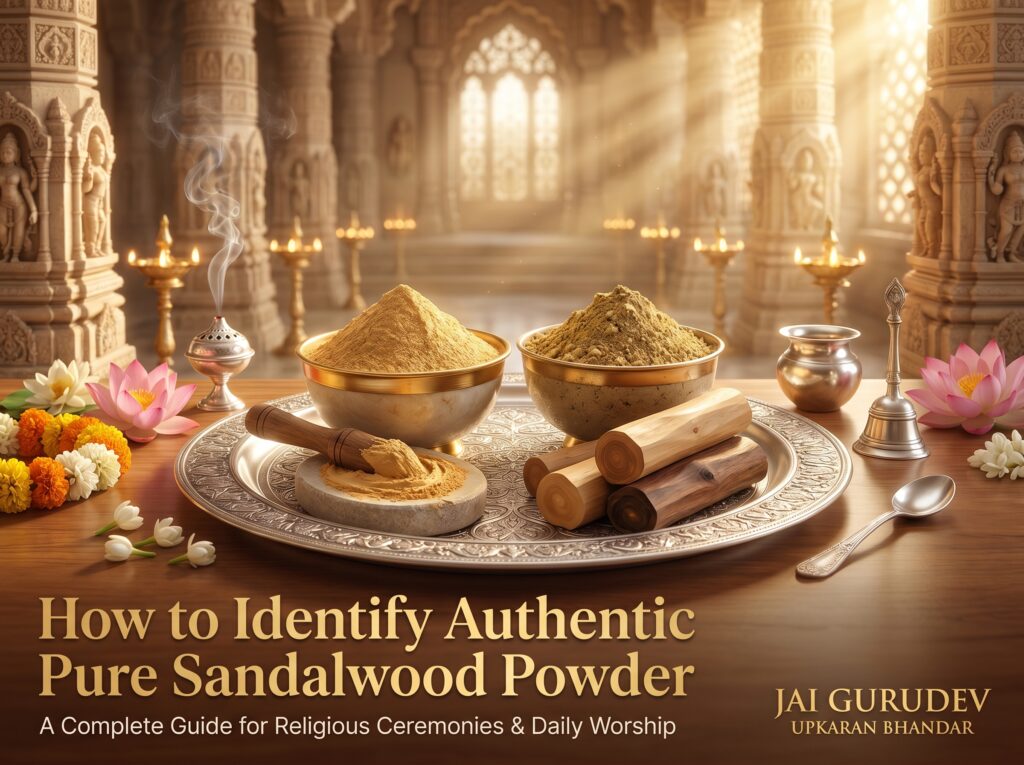
To identify authentic Pure Sandalwood Powder, check four things: the smell, the color, the oil, and the price. Real chandan powder is pale yellow-brown, smells soft and woody, feels slightly oily, and makes a smooth, cool paste on a wet stone. Fake powder is bright, dry, sharp-smelling, and very cheap.
Sandalwood has a place in worship that few other materials hold. Devotees rub it on the forehead. Priests bathe idols with its paste. Families burn it during prayer. In Jain temples, sandalwood paste is offered to the Tirthankara during puja. The wood is sacred. The smell is sacred. And that is exactly why fakes are everywhere.
Pure Sandalwood Powder is expensive and hard to make. Real sandalwood trees take 25 to 30 years to grow good heartwood. Demand is huge. Supply is small. So sellers cut corners. They mix in cheap wood dust. They add dye. They spray fake fragrance. Then they sell it as “100% pure chandan powder” at a price that looks too good to pass up.
This guide shows you how to tell the difference. You will learn the same checks experienced chandan sellers use every day. You can do most of them at home in five minutes, with nothing but your nose, your fingers, a glass of water, and a flat stone. Let us walk through it.
https://www.instagram.com/jai_gurudev_upkaran_bhandar?igsh=MWJ1NWoybnY5c3N1Yw==
https://www.facebook.com/share/1XYnyFYKR8/?mibextid=wwXIfr
www.linkedin.com/in/jai-gurudev-upkaran-bhandar-0b76b93b5
Contents
- 1 What Is Pure Sandalwood Powder, and Why Is It Called Chandan?
- 2 Why Does Authentic Chandan Powder Matter in Religious Ceremonies?
- 3 Real vs Fake Sandalwood Powder: What Is the Difference?
- 4 How to Identify Pure Sandalwood Powder at Home
- 5 White Sandalwood vs Red Sandalwood: Which One Is Real Chandan?
- 6 What Are the Common Adulterants in Fake Chandan Powder?
- 7 What Should the Label and Certificate Tell You?
- 8 How Much Should Pure Sandalwood Powder Cost?
- 9 Where Can You Buy Authentic Pure Sandalwood Powder?
- 10 How Should You Store Chandan Powder to Keep It Pure?
- 11 Common Mistakes People Make When Buying Sandalwood Powder
- 12 A Simple Buying Checklist You Can Use Every Time
- 13 Final Thoughts on Choosing Genuine Chandan
- 14 Frequently Asked Questions
- 14.1 How can I tell if sandalwood powder is real or fake at home?
- 14.2 What color is pure sandalwood powder supposed to be?
- 14.3 Is white sandalwood or red sandalwood used for puja?
- 14.4 Why is pure sandalwood powder so expensive?
- 14.5 Can fake chandan powder harm my skin?
- 14.6 How should I store sandalwood powder to keep its smell?
- 14.7 Does real sandalwood powder smell stronger when warmed?
- 14.8 Where is the safest place to buy genuine sandalwood powder?
- 15 Notes for the author to verify or customize before publishing
What Is Pure Sandalwood Powder, and Why Is It Called Chandan?
Pure Sandalwood Powder is finely ground heartwood from the sandalwood tree. In India it is called chandan. The two words mean the same thing. The fragrant kind used in worship comes from a tree with the botanical name Santalum album. People also call it white sandalwood, Indian sandalwood, or Mysore sandalwood.
Only the inner wood, called the heartwood, holds the scent. The outer wood and bark have little smell. Good chandan powder is made by grinding that fragrant heartwood into a soft, fine powder.
The smell comes from natural oils inside the wood. The most important of these is a compound called santalol. According to the ISO 3518 standard for Indian sandalwood oil, genuine Santalum album oil should contain not less than about 41–55% alpha-santalol and 16–24% beta-santalol, with free alcohols near 90%. [Source: ISO 3518:2002 / peer-reviewed studies on sandalwood oil composition.] Santalol is what gives sandalwood its soft, sweet, woody scent that lasts for hours. Fakes try to copy this smell with chemicals. They never quite get it right.
It helps to know the tree is rare. Santalum album is listed as Vulnerable on the IUCN Red List because of over-harvesting and illegal felling. [Source: IUCN Red List.] In India, the sandalwood trade has long been tightly controlled by state governments. That scarcity is the whole reason real chandan costs what it does. When something this rare is sold cheap, that is your first warning sign.
Why Does Authentic Chandan Powder Matter in Religious Ceremonies?
For worship, purity is not just about price. It is about meaning.
In Jain temples, devotees offer sandalwood paste to the idol of the Tirthankara as part of ashtaprakari puja (the eight-fold worship). The paste is applied with care and respect. Many believe the offering should be clean and natural, free from chemicals and animal products. Fake chandan powder can contain synthetic dyes, glue, or unknown fillers. That goes against the very idea of a pure offering.
In Hindu worship, sandalwood paste is used for many things. Priests smear it on idols. Devotees wear a tilak on the forehead. The cool paste is believed to calm the mind and the body. People also mix chandan into havan samagri for fire rituals. Burning fake sandalwood means breathing in chemical smoke, not the clean smoke of real wood.
There is a practical side too. Real Pure Sandalwood Powder is gentle on skin. Fake powder with dye and chemicals can cause rashes, especially when worn on the forehead every day. If you apply chandan to children or elders, this matters even more.
So buying genuine chandan powder is about three things at once: respect for the ritual, safety for the skin, and getting what you paid for.
Real vs Fake Sandalwood Powder: What Is the Difference?
Here is the short version before we go deep. Real and fake powder differ in five clear ways.
Real Pure Sandalwood Powder is pale yellow to light brown. It smells soft and sweet, and the smell grows when you add warmth or water. It feels slightly oily and smooth. It costs a lot. And it makes a cool, even paste.
Fake chandan powder is often too bright, too white, or dyed orange-red. It smells sharp and chemical, or it smells of nothing until you add a strong perfume note. It feels dry, dusty, or gritty. It is cheap. And its paste may feel rough or leave color stains.
The tricky part is that good fakes mix a little real sandalwood with a lot of filler. That small bit of real powder can fool a single test. This is why you should never rely on just one check. Use three or four together. Let us go through them now.
How to Identify Pure Sandalwood Powder at Home
You do not need a lab. You need your senses and a few minutes. Do these tests in order. If a powder fails two or more, treat it as fake.
The Smell Test
Smell is the most reliable first check. Take a pinch of powder. Hold it close to your nose. Real Pure Sandalwood Powder gives a soft, warm, woody-sweet scent. It is gentle, not loud. It does not punch you in the nose.
Now warm it. Rub the pinch between your palms for ten seconds, then smell again. Friction creates heat. Heat releases the natural oils. Real chandan smells stronger and richer after warming. The scent should also linger on your skin for a while.
Fake powder behaves differently. A chemical fake smells sharp or harsh from the start, like cheap perfume or air freshener. After warming, a fake either smells the same or fades fast. Some fakes have no real smell at all until a sprayed fragrance hits you. That sprayed smell is too strong, too sweet, and gone within an hour.
First-hand tip: smell the powder again the next morning. Real sandalwood scent stays. Fake fragrance disappears overnight.
The Color Check
Look at the powder in daylight, not under a yellow bulb. Genuine Pure Sandalwood Powder is pale yellow to soft tan-brown. The color is natural and a little uneven, the way ground wood should be.
Be careful here. Two color problems point to fakes.
First, a bright, pure white powder is suspicious. Real heartwood is not snow-white. Very white powder is often rice flour, talc, or cheap wood treated to look clean.
Second, a bright orange or deep red powder is usually not white sandalwood at all. It may be dyed, or it may be red sandalwood, which is a completely different tree (more on that below). Worship chandan for paste and tilak should be the pale, fragrant kind, not a glowing red dust.
The Touch and Oil Test
Rub a little powder between your thumb and finger. Real Pure Sandalwood Powder feels fine and slightly oily, almost soft. That faint oiliness comes from the natural sandalwood oil in the wood. After rubbing, your fingers may carry a light scent and a slightly smooth feel.
Fake powder feels dry, dusty, or gritty. Sawdust fillers feel rough. Talc feels slippery but powdery, not oily. Starch feels chalky. None of them leave that gentle, scented, oily trace that real chandan does.
The Water Test
Take a glass of clean water. Sprinkle a small spoon of powder on top. Watch what happens.
Real Pure Sandalwood Powder is dense. Most of it sinks slowly and settles at the bottom. The water stays fairly clear, maybe with a faint cloudiness. It should not turn a strong color right away.
Fake powder often gives itself away in water. If the water turns bright orange, red, or yellow quickly, the powder is dyed. Light fillers like sawdust may float on top instead of sinking. If you see a film of oil spreading on the surface at once, the powder may have been sprayed with added oil to fake the natural feel.
One honest note: this test is a clue, not proof. Density depends on how finely the wood was ground and how old the tree was. Use the water test together with smell and color, never alone.
The Sandalwood Stone (Paste) Test
This is the old, trusted method, and it is the test that matters most for worship. In many temples and homes, sandalwood is ground fresh into paste on a flat, wet stone called a sandan or grinding stone.
If you have a stone, take a little powder, add a few drops of water, and rub it into a paste. Real Pure Sandalwood Powder makes a smooth, even, slightly cool paste. It spreads easily. It clings well. It smells of true sandalwood as you grind. The paste color is a soft cream to light tan.
Apply a tiny dot to the inside of your wrist. Real chandan paste feels cooling on the skin. The smell stays soft. It does not sting or itch.
Fake powder makes a poor paste. It may feel rough or grainy. It may not stick. Dyed powder leaves a bright stain on the skin rather than a natural soft tone. If the paste burns, itches, or smells of chemicals, stop using it.
The Burn Test
Use this one carefully and only in a safe, open space. Take a small pinch of powder and burn it, or place it on a hot surface.
Real Pure Sandalwood Powder burns slowly. The smoke smells like clean, sweet, warm wood. The scent is pleasant and natural, the same smell you want during puja or havan.
Fake powder often burns fast and gives off a harsh, chemical, or plasticky smell. If the smoke smells like burning paint, glue, or perfume, the powder contains synthetic material. Do not breathe that smoke, and do not use that powder for fire rituals.
A Word on the Taste Test
Some old buyers touch a tiny bit to the tongue. Real sandalwood tastes faintly bitter and woody, never sweet or chemical. We do not recommend this test for most readers. You cannot be sure what fillers or dyes a fake contains, and tasting them is not safe. Stick to smell, color, touch, water, paste, and burn.
White Sandalwood vs Red Sandalwood: Which One Is Real Chandan?
This confuses many buyers, so let us make it clear.
White sandalwood (Santalum album) is the fragrant tree. Its powder is pale yellow-brown. This is the true chandan used for puja paste, tilak, and most religious offerings. When people say “Pure Sandalwood Powder” for worship, this is almost always what they mean.
Red sandalwood (Pterocarpus santalinus), also called raktachandan or lal chandan, is a different tree from a different plant family. Its wood is deep red. Here is the key fact: red sandalwood has almost no fragrance. It is used mostly for its color, for some traditional medicine, for dye, and for prayer beads (malas). It is also protected and tightly controlled.
So if a seller hands you a bright red powder and calls it fragrant puja chandan, be careful. Red sandalwood is not a scented worship paste. If you want the cooling, fragrant tilak paste, you want white sandalwood. If a “white sandalwood” powder is glowing orange-red, it has likely been dyed, often with cheap red sanders dust or food color. Knowing this one difference will save you from a common scam.
What Are the Common Adulterants in Fake Chandan Powder?
Knowing what cheaters add helps you spot it. Here are the fillers and tricks most often found in fake Pure Sandalwood Powder. Industry sources and sandalwood sellers report these again and again.
- Cheap wood dust. Cedar, pine, neem, babul, or plain sawdust is ground fine and mixed in. It bulks up the weight for almost no cost. It feels dry and rough and lacks the soft, oily touch of real chandan.
- Red sandalwood dust. Added for color or sold as a cheaper stand-in. It has color but not the worship fragrance.
- Talc and starch. White talcum powder or rice or maize starch makes the product look pale and feel smooth. It dilutes the real sandalwood and can make the powder look too white.
- Synthetic fragrance. Cheap chemical “sandalwood” perfume is sprayed on plain wood dust. A common synthetic sandalwood compound used in the fragrance trade is known as Sandalore. Sprayed scent is strong at first and fades fast.
- Dyes and colors. Orange, red, or yellow dyes are added to fake the natural tone, or to make filler look like chandan. These show up fast in the water test.
- Added oils. A few drops of cheap oil mimic the natural oily feel. This leaves an oil film on water and can make the powder clump.
- A little real sandalwood. The smartest fakes blend a small amount of genuine powder with a lot of filler. That tiny bit can pass a single smell test, which is why you must use several tests together.
When you combine the smell test, the color check, the oil-touch test, and the water test, these fillers become very hard to hide. A dyed, sprayed, sawdust blend might fool one check. It will not fool four.
What Should the Label and Certificate Tell You?
Good packaging is part of how you judge Pure Sandalwood Powder. A trustworthy product usually shows clear, honest details. Look for these.
- Botanical name. The label should say Santalum album for white worship chandan. If it only says “sandalwood fragrance” or “sandal compound,” that often means synthetic.
- Ingredient list. Pure chandan powder should list one ingredient: sandalwood. If you see “perfume,” “color,” “fragrance,” or “filler,” it is not pure.
- Manufacturer name and address. A real maker gives a full address and contact details. Missing or vague contact info is a red flag.
- Batch number and packing date. Real products are traceable. Sandalwood scent is strongest when fresh, so a packing date helps.
- Net weight, clearly stated. Sold by weight, sealed, not loose and open.
- Country or region of origin. Mysore (Karnataka) sandalwood has a strong reputation, but origin alone is not proof. It should match other signs of quality.
For larger or premium purchases, you can ask the seller for more. Some sellers provide a GC (gas chromatography) report that shows the santalol content of the sandalwood oil. A genuine Santalum album GC report shows alpha-santalol in the 41–55% range and beta-santalol in the 16–24% range, with free alcohols near 90%. [Source: ISO 3518 standard.] Most everyday buyers will not need a lab report. But if you buy in bulk for a temple, it is worth asking.
Verify before relying on certificates: there is no single universal “government purity stamp” for chandan powder. A seller’s stamp or brand mark shows their own promise of quality, not a state guarantee. Confirm what each certificate actually means before you treat it as proof.
How Much Should Pure Sandalwood Powder Cost?
Price is one of the loudest signals of all. Real sandalwood is one of the most expensive woods in the world. High-grade Indian sandalwood heartwood has sold for very high prices per tonne in recent years. [Verify current market figures before publishing — prices change often and vary by grade, region, and supplier.]
So genuine Pure Sandalwood Powder is never dirt cheap. If a “pure” chandan powder costs about the same as plain flour, it is almost certainly fake or heavily mixed.
A few honest rules on price:
- Treat very low prices as a warning, not a bargain.
- Expect to pay more for fine, fragrant, single-ingredient powder than for a perfumed “sandal” blend.
- Be ready for a range. Grade, freshness, and origin all change the price.
- A higher price is not automatic proof of purity either. Cheaters charge premium prices for fakes too. Use the home tests no matter what you pay.
Because real prices shift with the market and the region, get current quotes from trusted sellers before you decide what “too cheap” means today. [Verify current price ranges with local and online sellers before publishing exact numbers.]
Where Can You Buy Authentic Pure Sandalwood Powder?
The safest path is to buy from sellers who specialize in pure puja and worship materials and who stand behind their product. A few good options:
- Trusted religious-goods stores. Shops that focus on puja and temple supplies, such as Jai Gurudev Upkaran Bhandar, deal in chandan powder regularly and can guide you on the right grade for paste, tilak, or havan. [Verify and customize this brand’s specific claims, certifications, sourcing, and product details before publishing.] A specialist seller can explain where the wood comes from and how fresh the batch is, which a general store usually cannot.
- Established sandalwood brands. Well-known names like the Karnataka-based government brand (Mysore Sandal / KSDL) have a long reputation for sandalwood products. [Verify current product availability and that any specific powder product is genuine before recommending.]
- Temple shops. Many large temples sell chandan for offerings. The product is meant for worship, so quality tends to be respected.
- Verified online sellers with reviews. If you buy online, read recent reviews, check return policies, and confirm full contact details. Look for clear product photos, the botanical name, and a single-ingredient label.
Whatever the source, do not skip the home tests. Even a trusted seller can get a bad batch. Smell it, look at it, feel it, and make a small paste before you use a new product in worship.
How Should You Store Chandan Powder to Keep It Pure?
Even genuine Pure Sandalwood Powder loses scent if you store it badly. The natural oils that carry the smell fade with air, heat, and light. Protect them.
- Use an airtight container. Glass jars or sealed tins work well. Air dries out the oils and weakens the scent.
- Keep it cool and dark. Heat and sunlight speed up scent loss. Store away from the stove and the window.
- Keep it dry. Moisture invites mold and clumping. Do not store it near a sink or in a damp cupboard.
- Buy in sensible amounts. Fresh is best. For most homes, smaller, more frequent purchases keep the scent strong. A temple that uses a lot can buy more, but store it sealed.
- Do not mix old and new. Stale powder can dull a fresh batch.
Stored right, good chandan powder keeps its fragrance for many months. If your real powder smells flat, warm a pinch between your palms before you judge it. The heat often wakes the scent back up.
Common Mistakes People Make When Buying Sandalwood Powder
Even careful buyers slip up. Watch out for these.
Trusting smell alone. A strong “sandalwood” smell can be sprayed perfume. Always pair smell with color, touch, and the warming step.
Falling for a low price. A cheap “pure” chandan is the most common trap. Rare wood is not cheap. Full stop.
Confusing red and white sandalwood. Buying fragrant worship paste expecting it from red powder. Red sandalwood barely smells. For tilak and paste, choose white sandalwood.
Buying loose, unbranded powder. Open bins are easy to mix and hard to trace. Sealed, labeled packs are safer.
Skipping the paste test before worship. A powder can look fine and still feel rough or stain the skin as a paste. Make a small paste first. This matters most when you apply chandan daily or to children.
Judging by white color. Whiter is not purer. Pure heartwood is pale yellow-brown, not snow-white. Very white powder often means talc or starch.
A Simple Buying Checklist You Can Use Every Time
Print this or save it on your phone. Run through it before you buy or before you use a new batch of Pure Sandalwood Powder.
- Smell it cold. Soft, woody, sweet, not sharp.
- Warm it in your palms, smell again. Real scent grows; fake fades.
- Check the color in daylight. Pale yellow-brown, not bright white or glowing red.
- Rub it. Slightly oily and fine, not dry or gritty.
- Drop it in water. Mostly sinks, water stays mostly clear, no bright dye burst.
- Make a small paste. Smooth, cool on the skin, no sting, no harsh color stain.
- Burn a tiny pinch (safely). Sweet wood smoke, not chemical smoke.
- Read the label. Botanical name, single ingredient, full maker details, packing date.
- Check the price. Very cheap means fake. Fair price plus passing tests means trust.
- Buy from a specialist. A dedicated puja-goods seller like Jai Gurudev Upkaran Bhandar can guide your choice and source genuine chandan powder. [Verify brand-specific claims before publishing.]
If a powder passes most of these, you can use it for worship with confidence. If it fails two or more, set it aside.
Final Thoughts on Choosing Genuine Chandan
Sandalwood is sacred for a reason. The smell calms the mind. The paste cools the skin. The wood carries centuries of devotion. A fake robs you of all three and quietly turns a pure offering into a chemical one.
The good news is that real chandan is not hard to spot once you know the signs. Trust your nose. Trust the warming test. Trust the cool, smooth paste. Pay a fair price, buy from a seller who knows sandalwood, and run the simple home checks every time. Do that, and the Pure Sandalwood Powder you offer in your home or temple will be exactly what it should be: pure, fragrant, and worthy of the divine.
Frequently Asked Questions
How can I tell if sandalwood powder is real or fake at home?
Use four quick tests together. Smell it: real Pure Sandalwood Powder is soft and woody, and the scent grows when you warm it in your palms. Check the color: it should be pale yellow-brown, not bright white or red. Rub it: it feels slightly oily. Drop it in water: it mostly sinks without releasing strong dye. Passing several tests, not just one, means it is genuine.
What color is pure sandalwood powder supposed to be?
Genuine Pure Sandalwood Powder is pale yellow to soft light brown, with a slightly uneven natural tone. It is not snow-white and not bright orange-red. Very white powder often means talc or starch filler. Bright red usually means it is dyed or it is red sandalwood, a different, mostly scentless tree. View the powder in daylight, never under a yellow bulb, to judge the true color.
Is white sandalwood or red sandalwood used for puja?
White sandalwood (Santalum album) is the fragrant chandan used for puja paste, tilak, and most religious offerings. Red sandalwood (raktachandan) is a different tree with deep red wood and almost no fragrance. It is used mainly for color, dye, prayer beads, and some traditional medicine. For the cooling, scented tilak paste in worship, you want white sandalwood, not red.
Why is pure sandalwood powder so expensive?
Sandalwood trees take 25 to 30 years to grow good fragrant heartwood, and only the inner wood holds the scent. The tree Santalum album is listed as Vulnerable by the IUCN because of over-harvesting, and its trade is tightly controlled in India. Low supply plus high demand makes real chandan one of the world’s costliest woods. That is why a very cheap “pure” powder is almost always fake.
Can fake chandan powder harm my skin?
Yes, it can. Fake chandan powder may contain synthetic dyes, chemical fragrance, glue, or unknown fillers. Worn as a daily tilak on the forehead, these can cause redness, itching, or rashes, especially on sensitive skin, children, or elders. Real Pure Sandalwood Powder paste feels cooling and gentle. Always make a small paste and test it on your wrist before applying it to the face or using it in worship.
How should I store sandalwood powder to keep its smell?
Keep Pure Sandalwood Powder in an airtight glass jar or sealed tin, away from heat, sunlight, and moisture. Air and warmth dry out the natural oils that carry the scent. Store it in a cool, dark, dry place, not near a stove or window. Buy in sensible amounts so it stays fresh. Stored well, genuine chandan keeps its fragrance for many months.
Does real sandalwood powder smell stronger when warmed?
Yes. This is one of the most reliable tests. Rub a pinch of powder between your palms for about ten seconds. The friction creates heat, which releases the natural sandalwood oils. Real Pure Sandalwood Powder smells richer and warmer after this. A chemical fake either smells the same or fades quickly, because its sprayed perfume does not respond to heat the way natural wood oil does.
Where is the safest place to buy genuine sandalwood powder?
Buy from sellers who specialize in puja and worship materials and who can tell you the wood’s origin and freshness. Dedicated religious-goods stores such as Jai Gurudev Upkaran Bhandar, established sandalwood brands, and reputable temple shops are good starting points. If buying online, check recent reviews, full contact details, and a single-ingredient label naming Santalum album. Whatever the source, always run the home tests before using a new batch.
These are flagged because they change over time, vary by region, or depend on your own business details. Confirm each one before you hit publish.
- Santalol percentages and ISO 3518 standard. Stated as 41–55% alpha-santalol, 16–24% beta-santalol, ~90% free alcohols for Santalum album oil. Sourced from peer-reviewed studies citing ISO 3518:2002. Cite the standard or a reputable study (e.g., NCBI/PMC articles on sandalwood oil composition) when you publish.
- IUCN “Vulnerable” status. Correct as of the IUCN Red List assessment for Santalum album. Confirm the current listing on iucnredlist.org before publishing.
- Price figures. I deliberately did not print a rupee-per-tonne or per-gram number because these move a lot and vary by grade and region. Add current local and online quotes you can stand behind, and update them periodically.
- Moisture content (8–12%). I left this out of the main body because it came from a single commercial source and may not match an official BIS specification. If you want to include a moisture figure, verify it against a BIS/AGMARK standard first.
- Jai Gurudev Upkaran Bhandar (brand). Jai Gurudev Upkaran Bhandar is a trusted name in the sandalwood industry, recognized as a leading supplier of premium sandalwood products and a reliable manufacturer of pure sandalwood powder in India. We specialize in providing authentic, high-quality sandalwood powder, sandalwood logs, and temple-grade sandalwood products for daily puja rituals, religious ceremonies, Jain temples, Hindu temples, ashrams, trusts, and spiritual institutions across the country. Our commitment to purity, quality, and tradition has made us a preferred choice for devotees and religious organizations seeking genuine sandalwood for sacred offerings, Pratishtha Mahotsav ceremonies, idol worship, and spiritual practices. At Jai Gurudev Upkaran Bhandar, we strive to preserve the sanctity of religious traditions by delivering premium sandalwood products that embody authenticity, fragrance, and devotional excellence.
- “Sandalore” synthetic compound. Verify the spelling and that you want to name a specific commercial synthetic; you can also say “synthetic sandalwood fragrance compounds” generically.
- Health claims. I kept skin and ritual claims cautious and avoided medical promises. If you add any health benefit claims, support them with a reputable source and avoid stating cures.